Fantasies, Myths, and Fairy Tales, Part Four

At the top of Whiteface Mountain in New York
Several years ago, I wrote a couple articles titled, Fantasies, Myths, and Fairy Tales, denoting that what many people thought of as "solutions" to the predicaments we face were anything but. I weaved popular narratives of decades past to give a more realistic feel to the article, since many wildly optimistic ideas were floated back in the day that just didn't really have a chance of becoming reality before energy and resource decline took precedence over silliness. The same is true now, only just shy of 5 years since the first two articles were written. I added a third article about 8 months later and have added many different ideas since then which fit into this same theme. (See all three previous articles here and here and here.)
Overall, this is part of the whole obsession over solutions that I pointed out in The "Solution" Obsession last year. Basically, society in general suffers from the illusion that there is some sort of "fix" for what ails us. Unfortunately, there is no such thing as a "fix" or "solution" or "answer" because what we face is not a problem with a solution, but a predicament with an outcome. For instance, in this video from Nate Hagens (queued up to the 18:00 mark), he clearly identifies his non-acceptance of this fact with his question: "How are we going to solve biodiversity loss, climate change, energy depletion,...[etc.]?" The short answer, of course, is short and succinct: "We're NOT!"
I don't want to take away from the value of Nate's discussion with Nora and Zak because it highlights the fact that we have relationships with everyone and everything else if we simply are willing to look, and technology use tends to obfuscate these relationships in a way to maximize profit and turn to reductionism, as is being demonstrated with the AI boom. Technology use is causing us to atrophy pretty much across the board. Now that people spend so much time looking at screens rather than getting out and exercising, the physical atrophy that is being caused can be seen in the fact that a large percentage of American society today is obese. Some of this is caused by our diet, but lack of physical activity is a major contributor.
Now, take a look at what computer use (especially with AI) is doing to our brains and cognitive skills. The exact same thing is occurring there as well - atrophy (just look at attention spans). People are forgetting how to accomplish tasks that once were taken for granted. Many examples are brought up such as how to read a map or how to calculate 3-digit numbers (nowadays using GPS or calculators instead). Writing is becoming a lost talent (how many people can write in cursive?) as more people today use a keyboard instead. As this atrophying has taken place, we have forgotten who and what we are as a species and our place within the web of life. I pointed this out in The Illusion of Self and Separation.
However, I think one of the most important aspects to keep in mind is that all this technology is slowly going away. Energy and resource decline and collapse are two symptom predicaments of ecological overshoot which will take a large portion of today's technology away from us, and this means that it is extremely important not to base tomorrow's existence on how life is today because it is going to change dramatically over the next two decades in ways we generally cannot imagine today.
The Busy Worker's Handbook to the Apocalypse. Sam gave me permission to reprint his handbook here as a page, and the reason I wanted to reproduce it here is because it contains much of the same material regarding climate change being irreversible on human timescales as I tried to put in my original Denial of Reality article. It discusses items like "committed warming" and how CO2 in the atmosphere is there for centuries with little (if any) chance of removal at scale. I want folks to understand the difference between a predicament with an outcome and a problem with a solution, and I want people to realize that technology use is precisely what caused the predicament of overshoot, which is why it will never have any ability to "solve" it (even if the predicament actually had any ability to be solved in the first place). It also provides an even gloomier timeline than ones I frequently use here, although I routinely stress the fact that I am highly averse to giving timelines and the fact that the timelines I generally give are actually in the reference material I use here. This means that the timelines belong to those authors and not me.
All of this has led to the topic of today's article, highlighting the illusions we frequently like to distract ourselves with. Recently, I have had quite a few conversations with folks about collapse and extinction. One reader in particular went into questioning the value of knowing about extinction, and I pointed out how knowing can improve one's life by focusing on things of vital importance and rejecting fluff (unimportant items). Another valuable way to improve one's life is to opt out of the system as much as possible. Just because other people are doing something doesn't make it necessarily right or correct. Does it (whatever "it" might be) make ecological sense? If not, then perhaps doing something other than that might be a better answer. Learning how to consider our relationship to all other life on this planet and the planet itself is an important skill. Figuring out how to play a new video game, on the other hand, may not be the best way to spend one's time.
Still, there are other important skills to learn and ways to spend one's time that we have left for doing good things and rejecting bad ones. Who knows, perhaps one could spend time learning how to live like Indigenous tribes by joining them for a period of time. Keep in mind that it isn't going to change the trajectory of the predicaments we face. This is all about doing what one is passionate about regardless of what the outcome might end up to be. We already know what the outcome will be (as was pointed out in The Busy Worker's Handbook to the Apocalypse as well as in this article here). There are some who don't think this will be the case. All one really has to do is ask himself or herself, "Am I in The Big Club?" If you are reading this, you're not in The Big Club, and since you're not in The Big Club, you can rest assured that the outcomes listed above (3 sentences ago) are accurate (just for the record, those in The Big Club will also experience those outcomes, just probably later than most of us).
Now here's a funny post that John Peach alerted me to. Text quote:
Several Finnish cities, including Helsinki and Espoo, have integrated this technology into their district heating systems, a network of underground pipes that distribute heat efficiently across neighborhoods.
These systems capture the thermal energy generated by servers during data processing—typically considered waste—and redirect it to heat homes, offices, and other infrastructure.
Some of these data centers are located underground, taking advantage of natural insulation and freeing up surface space.
In Helsinki, for example, a well-known facility beneath the Uspenski Cathedral sends its excess heat into the city's grid, reportedly heating up to 500 large homes. Similarly, global tech giants like Google have developed data centers, such as the one in Hamina, that provide up to 80% of a neighborhood’s annual heating demand through waste heat recovery—offered free to the local utility company.
These systems not only reduce carbon emissions but also lower heating costs and increase energy efficiency."

Needless to say, the reason it's funny is because countless people on the post obviously cannot see that data centers themselves are unsustainable, and indeed, civilization is likewise unsustainable. So how they figure that this scheme is sustainable is really beyond me. How they figure that these data centers reduce emissions or increase energy efficiency is really magical thinking at work, since no figures on energy and resource use to build the centers is provided, nor are any figures provided for the maintenance of such infrastructure (which would point out the lie of the narratives). Most of these places will probably become brownfields within 15 years. Another issue is the pollution loading which is occurring and will continue to occur as a result of these centers.
Now, here's yet another laughable idea, this one brought out by a group including Simon Michaux, who should know better. I already pointed out precisely what The Venus Project is and why it can never be attained, and this is just more of the same. Michaux's plans center on SMRs (Small Modular [nuclear] Reactors), which, most likely will lose a great deal of their appeal once the reality of energy and resource decline sets in. Steve Bull points out this reality here in a comprehensive and revealing article.
I pointed out another idea in a different article that likewise can not be attained - an artificial habitat. These types of ideas of striving for the impossible are (at this point) a waste of time, but just like Biosphere 2, perhaps they will once again demonstrate why they were guaranteed to fail in the first place. Give it another decade or two and most all these ideas will be thrown in the dumpster.
Along the same lines of unattainable ideas comes this crap. That's the best that can be said for exactly what it is. People will believe it because it's what they want to believe, despite the fact that it holds no water at all. They're nice ideas, yes, but they don't conform to the exigent conditions that exist today. No different than Michaux's idea, they rely on yesteryear's conditions and cannot help but fail.
Speaking of crap, there's a hilarious idea emerging about what is known as "sovereign living" and many people clearly don't realize that there is no such thing. This is another flavor of "off-grid living" where people don't realize that one can rid themselves of utility companies, but only at the cost of convenience. Until one has done the extra work of living "off-grid" and also come to the realization that he or she still relies 100% on civilization, only then does he or she appreciate the fact that living separately from civilization is but an illusion.
The types of reductionism that I present here in this particular series of articles point to what amounts to dangerous delusions that society often suffers from. For instance, the so-called "energy transition" which never has taken place, since energy additions are what has actually happened. Art Berman explains deeper in this article what we're doing wrong. He goes even deeper in this article where he explains hemispherical thinking (left brain/right brain) and precisely why technical/reductionistic thinking can not and will not help, because the real trouble is our relationship with the life and planet which surround us. At the end, he signals what I wrote in The Illusion of Control and External Change Can Only Come About From Internal Change.
Along the same lines of unattainable ideas comes this crap. That's the best that can be said for exactly what it is. People will believe it because it's what they want to believe, despite the fact that it holds no water at all. They're nice ideas, yes, but they don't conform to the exigent conditions that exist today. No different than Michaux's idea, they rely on yesteryear's conditions and cannot help but fail.
Speaking of crap, there's a hilarious idea emerging about what is known as "sovereign living" and many people clearly don't realize that there is no such thing. This is another flavor of "off-grid living" where people don't realize that one can rid themselves of utility companies, but only at the cost of convenience. Until one has done the extra work of living "off-grid" and also come to the realization that he or she still relies 100% on civilization, only then does he or she appreciate the fact that living separately from civilization is but an illusion.
The types of reductionism that I present here in this particular series of articles point to what amounts to dangerous delusions that society often suffers from. For instance, the so-called "energy transition" which never has taken place, since energy additions are what has actually happened. Art Berman explains deeper in this article what we're doing wrong. He goes even deeper in this article where he explains hemispherical thinking (left brain/right brain) and precisely why technical/reductionistic thinking can not and will not help, because the real trouble is our relationship with the life and planet which surround us. At the end, he signals what I wrote in The Illusion of Control and External Change Can Only Come About From Internal Change.
Those same cognitive distortions are highlighted in this new study pointing out not only how people don't like change but also why they are resistant to such change. In many people's minds, casting or assigning blame and/or believing in fantasy "solutions" (which don't stand a chance because they don't address overshoot) offer easy ways to avoid the requirement of making personal change. Simply buy an EV, some solar panels, eat veggie burgers, and the "problem" goes away (in their mind only, unfortunately). One cannot buy, build, or donate their way out of the predicament of overshoot. Acceptance is the way to go, and that paves the way for the next step - action.
Can you be happy with less? Sure you can. It isn't easy, but it is possible. You will discover that relationships are more important than "stuff" and are what life really is about. Other sacrifices will also have to be made, as I have discovered. For instance, some relationships will have to go by the wayside, as they will no longer fit into your lifestyle. Once one understands and comprehends true reality, those who don't will want to continue ideas or ways of living that one already knows is impossible. The only thing one can do is shake his or her head and walk away. Remember beliefs versus facts.
Conspiracy theories, religions, and cults all suffer from the same root issue - belief over facts. This is very similar to Wetiko/Windigo, where a belief system trumps established facts. Humans are always seeking to find that utopian place which never exists in reality. It's because there is no universal perspective within society. If there ever was to be a utopian society, everyone would have to agree on how to live and how to resolve issues and disagreements when they inevitably arise. If just two individuals find it difficult to agree with each other in a marriage on how to live, it isn't going to get easier by adding more people to the equation. Yet, this is the simple fact of life - that everything is based on our relationships with the external world - other people, organisms, and things.
I've actually written lots of articles that go into this same category. One in particular pointed out the hopium and bargaining that often accompanies technological ideas focused on the attempt to "solve" what are in reality predicaments, preventing them from actually accomplishing anything and only worsening the existing situation and it explains why in the very first paragraph of this article. At the end of the day, acceptance of the predicaments we face is the only way to achieve true clarity and true calmness. It wipes away the need for "hope" (hopium) by securing the realization that no solution is forthcoming and that there is an immutable outcome that cannot be prevented. All the worry and anxiety is thereby released, understanding that collapse and die-off are the inevitable outcome which cannot be prevented. There are many people who deny this, denial being a frequent defense mechanism when faced with cognitive dissonance. I realize that they are suffering from special pleading, and, like I mentioned above, there is little to do but to walk away. Arguing with them is a waste of time and energy, because they suffer from belief over facts. They cannot be reasoned with and nobody is obligated to try. One either knows these facts or one doesn't (IYKYK). By the way, in case you haven't encountered that acronym, it stands for "If You Know, You Know."
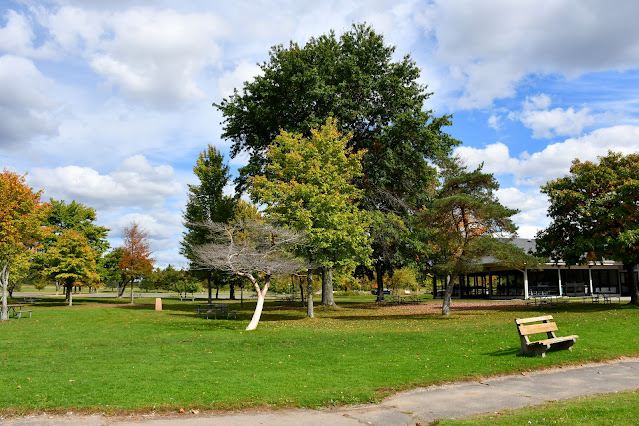
With that, it is time for something a little more pleasurable. Happy New Year to you; here's a look at Lover's Lane Boardwalk and Holly River State Park!





Comments
Post a Comment