Our Anthropocentrism and Psychology, Part Three

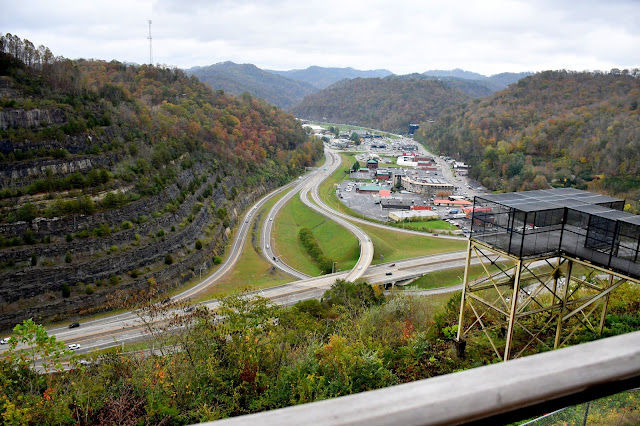
US 58 construction in Virginia at Lovers Leap
Recently, I have been investigating our compounding psychological trappings that bind us to an ever-increasing level of complexity that has stymied us ever since we first began developing it. To help get us started, here is a reel that gives us the basics. Underneath the reel, I explained it this way:
Steve Bull has also been working on explaining precisely why not only do we not have any solutions to fix, save, solve, or excuse ourselves from the set of predicaments we find ourselves in, but we are also condemned to watch the fruits of our labor over the past 12,000 years slowly dissolve into the ether (disappear).
The photograph at the top of this page is a microcosm of the situation (also see the story at the beginning of this post). What was once a wagon trail through the wilderness was transformed into a rough road, a smoother road, a wider road, a less curvy road, a less steep road, an improved road, a road with additional protection features such as truck runaway ramps, railings, and signage to alert drivers to potential issues, and, finally, into an even straighter and less steep road with four lanes. As a species, this is what we do - we innovate. We improve things by increasing their complexity. But there's a catch - despite the fact that the reason we do this is to "solve a problem" - we rarely look at the wider boundary to foresee the inevitable consequence(s) of doing so.
Nature built us to be able to solve problems using energy from food that we ate which provided said energy to our muscles and brain. When we transcended that system by utilizing technology to substitute for our brain and muscles, we then began to require more energy and resources for these new technologies in order to build them, operate them, maintain them, and at the end of their useful life, to dispose of them. Technology then, can be used to scale up our abilities to do far more work than we would ever be able to do by ourselves, but it also requires far more energy and resources as a result than what we require by ourselves.
We are extremely clever apes! However, cleverness is different from wisdom. What we didn't see at the time we devised all these awesome technologies was that they all create new problems and even some predicaments as part of their use, and that pollution is also produced throughout the process that previously hadn't been much of an issue before we scaled up these technologies (when we were hunter-gatherers, most all of our waste was biodegradable, and since we didn't congregate in large societies, the waste was scattered and easily broken down and reused by nature).
For instance, when we first devised weapons to help us kill animals to eat, we used bones and other animal parts, all part of the natural world which would break down over time and cause no real issues for us or other species. Even when we began using stone which was typically harder and more proficient as clubs and hammers, we were still utilizing materials that were natural and caused little damage to the environment surrounding us. However, once we began smelting metals, a material we found to be superior, we began loading the surrounding area with toxic amounts of waste material known as slag and tailings - pollution that was no longer able to be processed by nature in a short period of time and recycled into the environment without consequence.
Sadly, we continued scaling up more and more technologies using more and more types of materials, and enter modernity and we now have a huge predicament of pollution loading, just one of the many predicaments caused by our behavior of technology use. The main predicament we now suffer from as a result of our behavior of technology use is ecological overshoot. Pollution loading is just one of many symptom predicaments of overshoot including others such as climate change, energy and resource decline, biodiversity loss, extinction, soil erosion, disease, and more as shown here:

The reason for the picture is that most people understand carbon emissions as the "big problem" to be solved, not comprehending that emissions isn't a "problem to be solved" but a symptom predicament of ecological overshoot. As most everyone knows these days, it has an outcome, and that outcome is climate change combined with many others as a result of using the atmosphere as a waste sink for deposition. We've known since the 19th century that global warming/climate change/ACD would be a consequence of burning fossil hydrocarbons, discovered by Joseph Fourier in 1824, strengthened by Claude Pouillet in 1827 and 1838, added to by Eunice Newton Foote in 1856, clarified by John Tyndall in 1859, and fully quantified by Svante Arrhenius in 1896.
It is curious that almost two centuries later, we're still burning fossil hydrocarbons.
If we knew back in the 1800s that this would lead to climate change, why didn't we do something to change our behavior? So, we've been jumping off the cliff like lemmings since way back then (actually, this is a common myth in reality). The narrative and myth of human progress ("What, turn back?!! Now that we've come this far?!!") is most likely to blame, alongside our addiction to technology use, and the impractibility of attempting to convince society to turn back and reduce technology use. So, instead, now we supercharge everything by stamping on the gas pedal with AI.
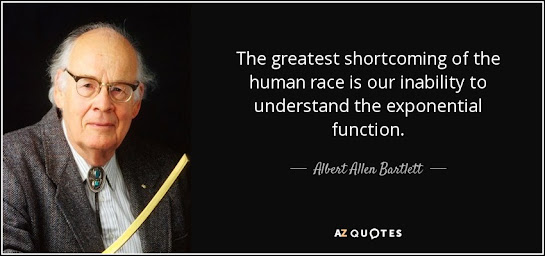
Now that I've properly introduced this article with the pretext, let me introduce you to what my regular readers will already know. Going back to another article by Steve Bull, (also see Part 2 here) he points out a rather simple, inconvenient fact:
Knowing this, I have written these articles here in an effort to help those around me understand that not only are we not going to solve any of these predicaments (they will be resolved by nature involuntarily in geological timescales immune from human opinion and emotion), but that we will instead double down on pursuing even more technological complexities in a futile effort to "solve" them. Steve's effort is to actually show people how special oil really is, why we depend upon the surplus energy it provides, and why, without it, civilization as we know it will end. Those folks who think we are going to electrify our way out of this are in for a big surprise.
Most people still don't appear to realize that civilization itself is unsustainable. There are whole groups of people working on coming up with "ecocivilizations" which is an oxymoron to begin with. Tons of folks still rely on hope to bring some sort of relief when in reality that is just a convenient way to keep yourself chained within the bars of one's own prison. Others look for the typical "solutions" that so many obsess over. The bottom line is that modernity (civilization) is but a blip in time; it cannot be made sustainable, period. Those who are into bargaining (one of the stages of grief) will discover that nature does not negotiate and does not care about our feelings. So, in truth, there is only acceptance that leads to real peace.
Many people tend to focus their attention on survival, which is a natural instinct, as one of their primary goals. While this is completely understandable, one of the mistakes being made here is that most all of them are making the assumption of conditions being exactly like or similar to today.
For instance, right now, most people have the freedom to be able to work on building a homestead where they can become far more resilient than the typical home property of today. The reality is that conditions are changing quite rapidly now, and what worked yesterday isn't likely to remain that way for long. Agriculture is changing rapidly in ways most folks never saw coming. Disease is becoming prolific in the animal kingdom; not only for humans but also for cattle and even wild species, making animal agriculture far more difficult. Drought is bringing farming of all types to a standstill and flooding the same. Wildfires are wiping entire properties out of existence. Occasionally, they're even wiping out huge parts of entire cities. Check out the before and after shots.
But what if the freedom to embark on such a project in the first place is taken away? These are all possibilities that must be taken into context before jumping into what may sound like a great idea but ends up becoming a nightmare. Nowadays, one can purchase a tract of land with this type of idea (establishing a farming homestead) only to find out that a data center is going to open up a few miles down the road which will take the water and power supply away from all the locals including you. Another issue I have seen repeatedly is the prospect of a dream property being bought only to face an existential crisis of wildfire or flooding destroying said property. For some people this may be just a part of life. For others, they might wish they hadn't gotten involved in such a scenario from the beginning.
At this point, if your homestead hasn't even been started yet, will you be able to accomplish your goal without a global supply chain? If you are simply buying a property that is all set to go and you already have the funds to do so, then go for it!
By the way, I encourage you to do whatever your heart is set on doing. Just because I see potential pitfalls in many of today's ideas doesn't mean that I intend to discourage others from following their dreams. Listen to Meagan McGovern when she says to "go out and fix things." My point isn't to stifle one's dreams, but not to suffer from optimism bias and plan a grand scheme without knowing the potential pitfalls beforehand. Once one knows what the risks are, he or she can plan accordingly and apply alternate plans as necessary.
I have featured Sarah Wilson's material here and in my articles before, but the one thing I see here in this article is a lot of anthropocentric viewpoints. I see talk about survival for humans but nothing about all the other species which we require for our own survival. In fact, I see this same set of circumstances in MOST articles, books, and other media covering overshoot, climate change, and collapse. This is where I have gotten the idea that the issue of collapse (along with the other two) has become bipolar - with people trying to "save" species, the ocean, or even the planet on one extreme and on the other extreme folks who are more or less trying to continue civilization any way possible. Knowing that neither way is actually possible given the existent conditions (the mass extinction we're in, condition of the oceans, the coming global temperatures, and energy and resource decline), it is all too evident that what will actually occur lies somewhere inconveniently inbetween, if anyone is still alive to witness any of it.
This phenomenon of anthropocentrism has been mentioned in many of my articles, but it is also alive and well with all types of new methods of agriculture, and as I already mentioned above and in previous articles about how all modern technology will come to a close within the next century, one can easily see how foolish some of these new ideas really are with regard to collapse:
I see all the same buzzwords, hype, and hoopla over all this wondrous technology and absolutely not one word about overshoot and collapse, despite the red warnings flashing quite literally everywhere. One brand new study shows how scientists have detected a sharp acceleration in climate change. This is exactly what has been predicted for decades now - there is literally nothing surprising here.
Something I can recommend contemplating is contained within an article I wrote back in 2022: are you running towards life or running away from death? It's an important question to ponder, as many people embarking on these survival projects might unknowingly or subconsciously be attempting to run away from death. Eliot Jacobson has a very thought-provoking article here which also has many excellent comments (along with a few moronic ones) underneath the story as well. I think it has rather valuable insights to share, demonstrating why acceptance is so important. I saw discussion of hope - and the one thing important to know from my own observations is that, as I mentioned above, hope is hopium. What one needs is courage, not hope.
As I pointed out last time, our own blind spot is thinking that somehow, industrial civilization (modernity) can be sustainable as long as we find the perfect technology to make it so. Unfortunately, this is a false belief that cannot be made true. Even blinder yet is the idea behind such fantasies that it's all about us - we fail to see and/or realize that by killing off other species through all of these "wonderful" technologies that we are undermining our own existence. Adrian Lambert has done the most excellent job of describing this scenario very simply in two separate quotes here:
"Well, politics cannot replenish depleted fossil fuels. Politics cannot restore ecosystems. Politics cannot deliver economic growth, when growth requires an energy and material surplus from a planet that we have already sucked dry.
I get so frustrated with the sustainability movement and the techno-optimists, who are often in bed with the media and political class to keep us consuming.
I was at an airport recently, and saw a bank advert with two people sat around a campfire with the slogan “Can we do more with less?” The notion of living more sustainably while about to board a plane that will ignite 150 tonnes of jet fuel under your arse is profoundly absurd.
Greenwashing at it’s worse.
In his excellent new paper, “Climate Gandalf” James Hansen expresses concern that the media coverage of El Nino will lead to the public misattributing man-made global warming to natural variability.
This is a ridiculous thing to be concerned about. Our problem is the cognitive and cultural filtering that enables us to discount the information.
Selective perception is how humans stabilise themselves when things are falling apart around them.
Hansen’s position also points to a more serious lie we tell ourselves; the notion that humans are capable of responding to ecological overshoot once it is recognised.
This is a false assumption.
All species will use all resources available to them in order to achieve their biotic potential (rate of reproduction). This is how nature works – our evolutionary drive to reproduce is undeniable.
For example, bacteria in a beaker will consume the nutrient medium to fuel binary fission until the jelly is gone. Without nutrients, the bacteria population will swiftly crash and die.
Despite our peculiar cleverness, humans are subject to the same energy constraints.
Humans have not escaped our beaker (The Earth). We found a vast store of fossilised nutrients, made the beaker eight times more crowded and established a sustainability committee to discuss the declining jelly."
Once again, we cannot escape who and what we are as a species. As one can see, I have resorted to repeating many of the same things I have previously said, changing the context somewhat and adding in material from others within the overshoot community. A while back, one reader complained that I wasn't adding in enough peer-reviewed material and that I was just using material from the echo chamber of the overshoot community. I asked myself what actually following those recommendations would accomplish above and beyond what I have already published and determined that the answer would most likely be, "Nothing." My efforts aren't really designed to change society because the essential facts can't be changed. We cannot make civilization (modernity) sustainable.
So many people associate climate change with doom, not seeing or realizing that it is a symptom of ecological overshoot. Without reducing overshoot, how likely is it that climate change can be reduced? Yes, I know that is a silly, rhetorical question, but it shall serve the purpose of demonstrating just how large our blind spots can be. One article recently published by Lyle Lewis can be helpful in highlighting this phenomenon, quote:
Like every other species, we depend upon finite landscapes, freshwater, soils, fisheries, and ecosystems with finite biological productivity. The laws governing those systems are indifferent to our politics, our philosophies, and our preferred explanations. Recognizing this does not require reducing every environmental problem to a question of population.
Nor does it require ignoring consumption, inequality, technology, or economics. It simply asks us to extend the same ecological reasoning to ourselves that we routinely apply to every other organism.
Ecological systems do not distinguish between organisms because of intelligence or intention. They respond to relationships, abundance, and demand."
Because we cannot escape who and what we are as a species, meaning that it isn't in the cards for us to voluntarily reduce overshoot, this means that nature will resolve the issue like it always does - collapse and die-off. It is therefore pertinent for us to reach acceptance. Once we accept the reality of all of this, we can once again continue with life and be at peace with ourselves and our fellow species we live with on this planet, knowing that the outcome of the predicaments we face cannot be essentially changed very far one way or another without severe consequences. Sure, we can geoengineer the planet by producing a nuclear winter, but this would most likely also end up wiping our species and many others out within a relatively short period of time. I highly doubt after the fact that we would see this as a wise choice. If we knew now the eventual outcome of introducing AI technologies, would we continue enveiling it as quick as we are? What if unveiling it as quickly as we are only supercharges the existing predicaments (such as climate change, energy and resource decline, and pollution loading) while providing nothing new existentially? So, it doesn't wipe us out by its own agency but does so through the same but turbocharged process of extraction and waste production as civilization already does. Oh, but we're such an intelligent species!
This concludes this series of articles (at least for now). I'm certain that I might find more material to add to this category in the future, but for now I will move on to new topics while also returning to my regular bi-weekly articles in two weeks. If you found this topic or these last three articles in the series enlightening, please let me know!





There are some really hard-hitting, eloquent, profound critiques in this essay, one of your strongest. I don’t think there’s anyone else in the collapse space who goes as strongly as you do into the reality of the dimensions of the predicament. However, I can only offer a critque of your tendency to resort to Dear Abbyism at the end, the instinct to offer people self help advice for the collapse-aware.
ReplyDeleteThis is embodied in this sentence:” Once we accept the reality of all of this, we can once again continue with life and be at peace with ourselves and our fellow species we live with on this planet, knowing that the outcome of the predicaments we face cannot be essentially changed very far one way or another without severe consequences.”
Nice goal, but “peace” is not going to be achieved during massive degradation and eventual die-off. Inner bliss is not going to come wafting out of droughts and floods and genocides and economic depression and idiot politics.
Each of us will live under the rules of our inherited social and biological reality, with some limited ability to adjust our psyches to mounting horror outside our doors. We’ll struggle until we die - even if fate bequeathed us some fossil fuel-based advantages.
Enhorabuena por el artículo Erik. No importa cuántas pruebas acumules sobre la insostenibilidad de la civilización, la mayoría se negará a aceptarlo, es por eso que quería comentarlo aquí, no estás solo.
ReplyDelete