Blind Spots

Rough Ridge Trail in North Carolina
I am currently on a trip as I start this article and enjoying the cool weather. It has been unseasonably cool for this time of year but I can't complain because I'd rather have the cool weather over the other extreme of too warm, which is increasingly looking likely for the remainder of this year.
The first part of this trip is taking in the Blue Ridge Parkway, although it is still not fully open yet. Worse still, most of the attractions along the route are also not open. Something unusual that I have never witnessed before; all the picnic grounds/areas that we have passed so far are closed off. The only ones open were located near the start of the parkway in Virginia. I don't know if this is because of government shutdowns, the elimination of so many park jobs, or what the issue is. I'm used to various attractions like restaurants and campgrounds being closed for the winter, but in previous years, picnic areas were open even when it was still cold at the higher elevations. Is it collapse-related?
With the sheer amount of road construction going on, one would never know that we are in collapse. There has been a noticeable drop-off in visitors at some locations where I am used to seeing far more people, but other places seem fairly normal. I did see where the parkway has contracted with a new concessionaire to provide food and services at the Mabry Mill Restaurant, which was also closed. I found out after I returned to Indiana why the restaurant was closed.
Blind spots - we all have them and I'm not immune from them any more than anyone else. Still, the one thing that always surprises me is how many scientists and even wide boundary generalists like me miss specific facts about the systems which surround us - basic facts that aren't going to change despite all sorts of hype to the contrary (see one of Steve Bull's latest eye-opening articles regarding technological "solutions" and ideas here and here and here). When a person doesn't understand that civilization is unsustainable, he or she will attempt to use all sorts of these ideas to try to "solve" what can't be solved because civilization isn't a problem to be solved; it is a predicament with an outcome. Collapse is that outcome - there is no alternative despite all the hype.
The inspiration for this article came from the 2008 documentary, Blind Spot, and here's the description from the page:
There is no panic in this film...just an absolute and stark reality that we either choose to face or not.
But you will not see this film on network TV or just about nowhere [sic] else. It challenges too directly fundamental assumptions on which the continuance of our corporate economy and our consumer culture is based -- in particular, the unquestioned assumption that growth is good, that "expansion is tantamount to progress."
"Blind Spot" makes no attempt to soften or sweeten its message in order to make it palatable to a wider audience. The people interviewed are blunt about the seriousness of the problems we face: peak oil; climate change; population overshoot and a diminished environment.
Whatever temporary progress we make in curbing these problems is quickly nullified by a growing population and the fact that increased technological efficiency in the use of a resource tends to increase (rather than decrease) the rate at which that resource is consumed.
These problems have potentially catastrophic consequences for the entire human species; indeed, we run the risk that positive feedback loops will develop that take matters completely outside our control.
And we've largely squandered the last forty years, precious time that we desperately needed to plan for these imminent crises."
This film was one of many which formed my original view of overshoot, and one of many different documentaries I watched on Netflix back when it was new and didn't have many new movies yet but had lots of documentaries.
A friend of mine pointed out one blind spot in particular in my group regarding a recent video from Nate Hagens and Art Berman:
"Berman calls the launching of the war a blunder. As if the American ruling elite had a choice, and could just let the China ruling elite take control of the Persian Gulf. Here's the comment I posted at the page:
'Problem is, Art Berman, and you, Nate, analyze entirely from a material goods bookkeeping perspective, how the global system functions materially. But the existing global system is not simply a material system, in fact it is primarily NOT that. Instead, the system functions on the basis of reproducing capital, at an ever enlarged level. And it functions on the basis of competition between the owners of chunks of capital, particularly the owners of the largest chunks.
In their calculations, control of the Strait of Hormuz is a matter of which one or ones of the competitors survive the next culling, which is where we are quickly headed. WW1 and WW2 were not fought with material bookkeeping in mind, but with the aim being global domination. Don't expect WW3 to be any different, and given the finite nature of the planet, WW3 is written into the hardware.' "
Another blind spot is emerging right now. The AI craze is going to cause its own demolition as pointed out by a recent paper condensed here:
"Every CEO knows AI layoffs will collapse their own market. Not one of them can stop. A paper from UPenn and Boston University mapped the exact math behind this. Not a prediction. Not a think piece. A game theory proof that rational, well-informed executives will automate themselves into a demand cliff, even when they can see it coming.
And since I first posted about this? The proof is playing out in real time. 150,000+ tech jobs cut in 2026 so far. Meta is laying off 8,000 people this week. Oracle gutted up to 30,000 in a single restructuring. Amazon has cut 30,000+ since October.
Cloudflare slashed 20% of its workforce after AI usage jumped 600% internally.
PayPal just announced plans to eliminate 20% of its people. Upwork cut a quarter of its staff. Block already halved its entire company back in February.
And every single one of these companies is reporting strong earnings while doing it.
The logic is simple and it's brutal. You automate. You cut labor costs. You survive the quarter. But the people you fired were also your customers. So was everyone else's fired workforce.
When every company runs the same playbook at the same time, purchasing power across the entire economy contracts. You end up with boundless productivity and zero demand. The researchers call it a Prisoner's Dilemma, and that's exactly what it is.
If you pause automation to protect jobs, your competitor doesn't. They undercut you. They take your market share. They put you out of business.
So nobody pauses. Even the firms that see the cliff keep their foot on the gas.
Here's what makes the paper really uncomfortable. They tested every popular fix against the math. UBI? Doesn't change the per-task incentive to automate. Capital income taxes? Kicks in after the decision is already made. Worker equity? Narrows the gap but can't close it. Upskilling? Same. Collective bargaining between companies? The incentive to defect makes every agreement fall apart.
None of them work. The only thing that moves the needle in their model is a Pigouvian automation tax. A fee that prices the economic damage of displacing a human worker directly into the cost of replacing them with AI. It changes the calculation at the exact moment the CEO is deciding whether to automate that next task.
Now look. I'm going to be honest. I don't agree with slapping a tax on automation. (Read that as: no fucking way.) And I think anyone who thinks government can surgically price externalities across every industry, company size, and job type is living in a fantasy. But the underlying problem the paper identifies? That's real. That's happening right now. 150,000 jobs gone in four months and accelerating.
These aren't companies in trouble. Oracle had record earnings before the cuts. Meta is spending $130 billion on AI infrastructure this year while showing people the door.
The paper calls it the "Red Queen effect." Better AI doesn't fix the problem. It makes it worse. Every firm runs faster just to stay in the same place while the ground erodes underneath them.
I'm not sitting around waiting for governments to figure this out.
I'm watching where the money flows, what sectors get hit hardest, and where the asymmetries create opportunity.
Because that's what this is. The biggest structural economic shift in decades, happening in plain sight, while most people are still arguing about whether AI can write a decent email.
The paper is free if you want to read it: "The AI Layoff Trap" by Brett Hemenway Falk and Gerry Tsoukalas (March 2026). It's dense. Throw it into an AI and get the summary if the math isn't your thing. The link is in the comments. But pay attention to what it's actually saying. Because the market already is."
Steve Keen has been talking about this for a while now as seen in this post from February 7. Geoffrey Deihl explains the multitude of issues surrounding AI and data centers here. If one looks at this scenario seriously, one comprehends that the same behavior that brought ecological overshoot into focus is driving the inevitable collapse into an even deeper crisis with the AI boom (and crash). We've actually seen this movie before:
"In the 1830s, everyone in the USA knew that canal waterways were the future of commerce. Every state started building a canal network with the vision of hooking them all into a national network. In 1837, there was a Great Recession, and the tax base for the canal work collapsed. When the economy recovered five years later, the railroad boom was happening and everyone knew that canals were over. That's why every city in the midwest has a half-finished canal in it. This is a post about data centers."
That was a post on @threads by galvanicklucipher. Now, take into consideration that no recovery will be forthcoming this time around. No new technology will be coming to "save" us because every new technology previously only worked because there was an ample supply of surplus energy to power it and plenty of resources were available from that surplus of energy to build that new technology. It worked, but at the cost of overshoot. This time, energy and resource decline, one of the symptom predicaments of overshoot, will prevent another "boom" cycle from happening. Think of the Great Depression (of the 1930s) on steroids, occurring in perpetuity. Originally, this appeared to be very slowly creeping over the horizon. Now, with the Iran War, the AI boom, and concurrently happening extreme weather events, one can see the supply chains that keep civilization humming along slowly breaking down. At the same time, one can also see the infrastructure that surrounds us slowly fading as well. Buildings, equipment, roads and the transport network, and all kinds of other infrastructure (including the nodes of government) are all becoming deficient due to years of deferred maintenance, funding being suspended, or workers responsible for said maintenance being laid off, sent to other locations and/or jobs, or otherwise reassigned within a district.
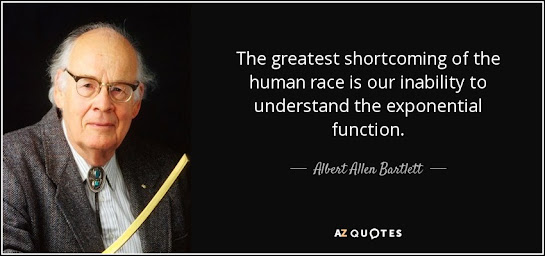
It doesn't take a rocket scientist to see what the outcome of all this will be. Without adequate energy and resources to maintain that infrastructure, the infrastructure itself will continue deteriorating to the point where it cannot be depended upon. Perhaps we're already there...see here and here. At that point, the infrastructure will be shut down or otherwise idled or turned into a sacrifice zone. Sometimes, sacrifice zones must be established due to man-made disasters. The only constant here will be the exponential nature of collapse.

The real trouble contained within that screenshot above is divulged about ecosystems sacrificed. Ecosystems sacrificed is precisely what civilization is all about. It is supported by technology use from the basic technology of agriculture up to the advanced AI systems and data centers now being established in an effort to control that which cannot be controlled. If you think about it, what happens when you destroy the ecosystems around you through technology use? You wind up causing the extinction of the species which rely on those ecosystems. We've been causing the extinction of species for thousands of years and this is precisely why we're in a mass extinction now. Attempting to continue that same system of technology use will continue to erode the very systems we depend upon for our own existence. For a species that is supposedly so intelligent, why are we doing this?
At the end of the day, it really doesn't make much sense, does it? It truly is one huge blind spot, caused mostly by ignorance and cultural conditioning. I mentioned Steve Bull above, but here is an article of his pointing out said cultural conditioning quite well with the constant stream of advertising/marketing designed to get people to buy into these types of narratives. It's unfortunately what our species does.
So, I could go on and on and on, continuing to outline where we are and how we arrived here, and what can be done about it to try to minimize the damage (being a predicament; it has an outcome, not a solution). However, rather than repeat the same material over and over, I'm going to talk about something I have mentioned a few times in the past but don't mention often enough. Then I'm going post a few links that hopefully will give you some inspiration to get started on your own journey.
This topic is Stoicism. Why is Stoicism so important? Because it helps one focus on facts and relationships. If you sit with this topic for any length of time, you will come to realize that everything about life rests upon relationships of one sort or another. With regard to overshoot, it is our lack of regard for our relationship with nature that has put our species and many others at risk of extinction. It should be obvious that we have neglected our relationship with nature, but because of our cultural conditioning, indoctrination into what passes as norms in today's society, and constant streams of propaganda, marketing, and advertising, most people are completely oblivious to our relationship with nature.
Last year, I published an article detailing the first step to behavioral change. Comprehending that there is a problem with our behavior and that said problem is most likely caused by a false belief is the first step (acceptance of the true facts). Stoicism stresses several facts that many people get confused with false beliefs. How often have you heard someone claim, "You made me angry!"? In reality, nobody has agency over other people's feelings and emotions, and the other party didn't "make" you angry - you chose to be angry. You simply played the blame game. The only person whose emotions and behavior you have control over is your own. It is therefore your own responsibility to reel yourself in when you realize that something or someone has triggered you into a response that you may end up regretting. Generally, this response is actually an emotional reaction, often an equal but opposite action based upon an initial perceived slight of some sort. However, human behavior is complex and such a simple example can only explain the easiest of behaviors that may cause an individual to experience anger, sadness, or other emotion that may influence a particular behavior that frequently is maladaptive without further evaluation.
That evaluation is much more important than many people initially think because it identifies your primary goals and also any actions that may work against those goals. Rather than react to people and situations (based on impulse), it is better to think about these things first and then respond. One must practice these things regularly in order for them to become habit. Many behaviors that once were routine for our species have become atrophied due to non-use, not much differently than our muscles. Everything's connected - our mental state mirrors our physical state and vice-versa. Sports professionals must train regularly to stay on top of their game, and it is no different for mental tasks that help us to stay alert and in good health. Practice makes perfect.
Being that relationships are so much more important than most of us realize in our day-to-day interactions, emotional regulation is vital. Recently, I stopped wasting time posting social media updates. Most of my friends are not interested in overshoot like I am, so there was either little or no engagement or there was disagreement.
So frequently, people get the idea that what I am attempting to promote through my Live Now ethos is to "do nothing." Nothing could be further from the truth. What I am attempting to promote is for folks to find their passion and then do it, whatever that may be. Many people want to focus on some sort of salvation, such as "fixing" climate change, or pollution loading, or energy and resource decline, or even "saving" species. Their goal is noble, but they are seeing each and every one of those items as a problem to be solved rather than the predicaments they actually are. Because they are predicaments, they have an outcome, not an answer or a solution. So their efforts may be noble but are ultimately misguided. Furthermore, they are setting themselves up for failure because the goal is unachievable. I actually got caught up in that hoopla myself, before I realized that my efforts were based on fear, not logic; which is precisely why I now promote Living Now, which can still include those ideas if that is what one is passionate about.
For instance (with regard to the "fixing" issue), here is a quote about trees that is very accurate:
Trees are great. Forests are important. But not every landscape is supposed to be a forest.
Species-rich grasslands, peat bogs, heathlands, wetlands and open moorland support wildlife that disappears when everything is covered in trees. In some cases, planting trees can even reduce biodiversity, increase water consumption, or damage ecosystems that already store vast amounts of carbon.
The obsession with tree planting often turns a complex ecological question into a simple numbers game. "look how many trees we planted".
A better question is: What ecosystem belongs here?
Nature is more diverse than a tree count."
Therein lay the fault of logic, where we think that we know more than nature does. Biomimicry, in this sense, is the highest form of flattery. But we can still get things wrong within that process. Once again, attempting command and control of nature for anthropocentric purposes will still have an unintended outcome and one we will not like. Because we are only a part of nature, we can not and will not be able to effectively emulate nature because nature's complexity is still beyond our grasp. To think otherwise is pure hubris and demonstrates our arrogant approach to life (and thus the current mass extinction we are in).
So, rather than attempt to continue the same unsustainable system of civilization that we currently reside within albeit in a slightly better form (notice that "slightly better" is still unsustainable, so ultimately these incremental changes [even if they were ALL implemented] are still unfortunately more or less irrelevant), perhaps a better choice is to seek acceptance and courage to face reality.
Here is an article about what to do when the world feels broken, and I think that part of the article is actually incorrect. The part that discusses hope separates it into two different types of hope - passive hope and real hope. The trouble is that what it is calling "passive hope" is actually what hope is, and what it calls "real hope" isn't hope at all, but courage. In order to reach true acceptance, one must abandon hope altogether, because hope is hopium. Grab courage instead and do what must be done. Make it (things, conditions) go right. Overcome, adapt, and improvise. All the hope in the world won't help. Here's the companion video to the article at the top of this paragraph.
In essence, doing what you are called to do is a matter of doing the right thing for you, regardless of what might be a popular activity/narrative/behavior. For instance, when I first learned about overshoot and especially about energy and resource decline, my first reaction was to plan a solar system, with a charger, power inverter, and battery system. I actually purchased several components before I realized that my actions were being promulgated by fear of loss of electricity, not by a true need for it to survive. Since then, I have met several friends who live with far less electricity than I do, and whether they have solar systems or not demonstrated that such a quality was more or less totally irrelevant. Those who didn't learned how to live without electricity and those with the solar systems simply had far more money to purchase lots of expensive equipment which will only work as long as it is maintained and occasionally replaced and/or upgraded. This informed me that the real job here is to learn how to live without electricity, not how to spend vast sums of money to try to extend that which can't be extended. People who have these systems will be forced into parting with their wealth in order to maintain the status quo rather than accept the truth - that our way of life is coming to an end. In other words, they are being slaves to the system rather than learn a new way of living. This appears to be a huge blind spot with most of society.
Some people have likened my ideas to being Malthusian or claimed that I want to "go back to living in caves" or similar themes. In reality and to be totally honest here, this is NOT what I want. I simply see that this is a possibility that we will eventually be forced into, whether we like it or not. Does nature care about our whims, our goals, and/or our feelings? Nope. Nature is just nature. The technology that we often take for granted today is slowly going away. I don't think any of us will like it. But there will not be another option because the energy and resources required to continue these systems is becoming constrained. Wars are being fought for control of those resources, and much of that energy and resources is being wasted in the fighting, among many activities wasting what precious resources are left.
We haven't yet been able to build a self-contained biosphere here on Earth, so why are the narratives about building one on the moon being spread far and wide? Perhaps seeing beyond those blind spots is the better idea. If you liked this article and the ideas brought forth by it, please share it with your friends. Despite the predicaments we face, I still feel the need to spread awareness.
As usual, here are today's new sources of inspiration, Balsam, North Carolina, and Lake Julian Park and Lake Powhatan Recreation Area and Campground!





Comments
Post a Comment