Hey, Have We Tried Honesty?

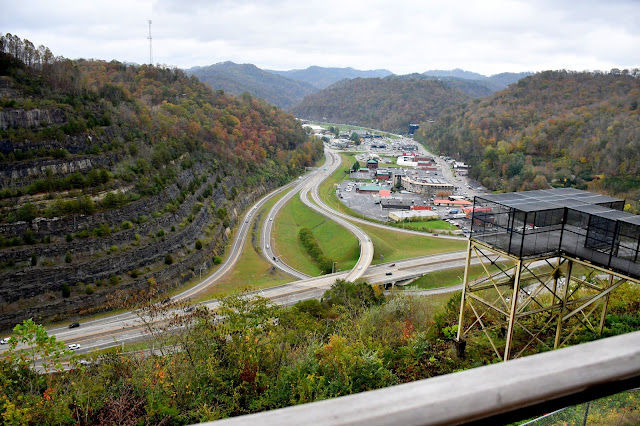
Picture of Monterey, Virginia, taken from Sounding Knob Fire Tower
The topic of honesty has been brought up here many, many times. However, it wasn't the word "honesty" that was ever used. Instead, I have used the words "denial of reality" to point out how we frequently lie to ourselves to reduce the anxiety of cognitive dissonance, among other reasons. Recently, the topic of honesty was brought to my attention as yet another idea being presented as a "solution."
The absolute pervasiveness of the solution obsession is almost humorous if it wasn't so sad. Then again, this is proof positive of our consistent and constant trait of innovation. It's also proof of our denial of reality of the fact that solutions are really just bargaining. But what would or even could honesty do about the predicaments we find ourselves enmeshed within? One person brought this article to my attention and asked me if this was a solution. So, can honesty solve these predicaments?
Of course, such a question is ludicrous, both initially on the surface and deeper within the reality of who and what we are as a species. Predicaments cannot be solved, period. They are not problems. They have outcomes, and while many people believe that we have an ability to use our intelligence and ingenuity to come up with ideas that can reduce the severity of outcomes, this is based upon an individual's ability to do so. Unfortunately, it doesn't work on the scale of hyperobjects because we cannot control hyperobjects because of our lack of agency and our inability to form a universal perspective.
I grew up loving music and electronics, especially sound systems. I always had a special fascination with loudspeakers and amplifiers. Later, I developed a fascination with signal source equipment such as microphones, turntables, tuners, cassette decks, CD players, VCRs, DVD players, and on and on. I actually still have a reel to reel tape player (as well as all the previous equipment listed). I then developed a fascination of signal processors such as graphic equalizers, electronic crossover networks, gates, limiters, compressors, mixers, sonic maximizers, and so on. I still have all of that equipment too. I began DJing in 1981 at small gatherings (mostly just friends and classmates) and as I delved deeper into the industry, I developed a fascination for lighting equipment as well, partly fueled by my involvement with theater production in large venues. At that point, I never really entertained the idea of building my own sound company where I would specialize in weddings, and not only be responsible for wedding receptions, but officiate and run wedding ceremonies and rehearsals as well. It's kind of funny how these things happen.
Anyway, one of my jobs included conducting pre-marital counseling for couples getting married. The simple fact is that no two people are going to agree 100% on everything, which sets the stage for arguments, debates, and other issues not only for couples, but for their whole families. Scale this simple fact up to societies, classes, countries, and other players on the global stage and one can easily see precisely why there is no such thing as universal perspective. There just has never been one, there isn't one now, and there never will be one.
Going beyond that, however, one can ask other questions about honesty. Can being honest reverse climate change? Can being honest reverse the mass extinction we are now in? Can being honest make civilization sustainable? These are obviously ridiculous questions on the surface, but even going deeper provides nothing of substance aside from the same old bargaining to maintain civilization that cannot be maintained because it isn't sustainable.
Once again, what we really have here is a noble idea, but not one that has any ability to extract our species from the predicament of overshoot. Is it a good idea? I think that honesty will, as the author states, become more and more of a reality as civilization collapses and the technology use that fueled the need to lie to support the common narratives of human ingenuity and human progress fail as even the "rabble" of society begin to see that these narratives hold no water and the emperor has no clothes. But as for the ability to "solve" any of the predicaments that we face, it is not one bit different than any of the other ideas I've seen. They all fail for the same reason: they are attempting to solve that which cannot be solved.
The reasons that our species has entered into overshoot are multi-faceted, and there is no doubt in my mind that most people never understand the full truth as to why because of the sheer amount of lying - narratives and propaganda designed to protect the status quo and the people at the top of the Ponzi scheme we know as civilization (modernity). But sudden truth now (while still a great quality) won't fix the structural elements of how we arrived here. Civilization will remain unsustainable regardless of any of the ideas centered on continuing it. Climate change will continue to worsen for decades even if we were to suddenly reduce emissions right now. This is not to say that we shouldn't attempt to reduce them anyway, but that requires reducing overshoot, and nature is already working on this right now through many of the symptom predicaments like climate change, energy and resource decline, pollution loading, and extinction. Herein lay another fault of logic regarding honesty being a "solution" - the structural elements of who and what we are as a species remains unchanged regardless of whether we are honest or not.
Last but not least, at the end of this article is another piece of the puzzle that should be addressed:
Right here is yet another failure point of the idea espoused by the author. His mistake is thinking that our species is logical and rational. It is not. Individuals can be logical and rational, but in group settings, the psychology of the group changes, tribes emerge, and ego begins to take over. I imagine I could write several articles about ego, but I shall refrain at this time. We are not rational, but a rationalizing species. Quote: "...universal emergence of goodness among human beings." Once again, we do not have the ability for universal perspective, so "universal emergence of goodness" is likewise a concept borne of hopium, no different than global unity, world peace, and utopian society. Hope and optimism can be seen through Stoicism, and in this manner, one can also see that the idea of honesty being able to deliver what is being marketed here reeks of sheer bargaining.
On a connected note, this article tells the story of collapse from a historical perspective and how humans act and the cycles each society goes through from a political and economic lens. The only missing part here is the ecological lens that dictate the outcomes today. It's an excellent article that really explains the cycles well, adds in this study of the "asshole threshold" (which sort of mirrors my articles about beliefs versus facts and false beliefs and denial), and points to Peter Turchin's prediction from 2010:
Turchin published the prediction in 2010. Check the tape."
Like so many other ideas which are noble and borne of the best of intentions (restoration comes to mind), the ideas are great for individuals to work towards if one's passions point to such, but they are not solutions to the predicaments we face, and most if not all don't scale up to what is required in the time available, which I would suggest has run out. This doesn't mean that individuals can't or shouldn't embark on such projects, just that the outcomes frequently stated as reasons to work towards them cannot be accomplished or cannot be accomplished in the timeframes available. In other words, these ideas that we have the ability to turn the ship around don't take into consideration the size of the ship, the size of the system it is embedded within, the speed with which it is moving, and the inertial velocities of the systems involved. All we really have the ability to accomplish is to rearrange the deck chairs on the ship before it begins sinking.
I saw something in an article recently that went something like, "Live for today, forget about tomorrow." I need to make clear that this is not what Living Now means or what it stands for. It means devoting oneself to his or her passions now rather than procrastinating and doing so with an eye toward the future that is coming. Do you have a project that is calling your name? Do it now while you still have the chance and ability to do so. Tomorrow may be too late, as tomorrow is never a certainty. All one ever truly has is today - yesterday is gone and tomorrow has yet to be born. With that, here are today's entries for natural inspiration; Jennings Randolph Lake and Robert W. Craig Campground!






Comments
Post a Comment