Happy Holidays! I Have Brought Hopium!

Looking down the trail at Whiteface Mountain, New York
Recently, an article from scientist Silvia Pineda-Munoz caught my attention. Most of the article goes into detail about how sea turtles have survived countless mass extinctions but are threatened (as are most marine animals) once again and most likely will not make it this time. That part of the article was great; what really garnered my focus, however, was this quote:
"So what can we do?
We can support organizations working on turtle conservation, reduce plastic waste, protect nesting beaches, and share their story so others understand what is at risk. Because once these survivors are gone, the oceans will never be the same."
It's a nice laundry list of things that either cannot be accomplished or won't make any difference, unfortunately. This same scenario presents itself time and time again in each situation involving symptom predicaments of ecological overshoot.
Supporting turtle organizations? How well has this worked to date? Apparently not very well or they wouldn't be threatened.
Reduce plastic waste in a civilization that continues manufacturing plastic waste? Hahaha, not gonna happen anytime soon.
Reduce plastic waste in a civilization that continues manufacturing plastic waste? Hahaha, not gonna happen anytime soon.
Protect nesting beaches? Yeah, sea level rise and extreme weather events will make that one impossible.
I'm sharing this story, but because I understand this as a predicament with an outcome and not a problem with a solution, I realize that sharing it is more or less irrelevant to the outcome.
What I find overwhelmingly saddening is that so many scientists are reductionists without realizing it. It's such a shame because if they just widened their boundaries to see the bigger picture and began to understand these things as predicaments instead of problems, perhaps they could come up with more realistic goals, such as reducing overshoot. I suppose I can fantasize a little bit on that. At least I understand that doing so is just good old hopium.
I know, I know, I must not reveal the truth that we aren't as special and intelligent and ingenious as we think we are. It does get disheartening to watch society go through all kinds of pointless gyrations in an effort to come up with "solutions" to all these "problems." It only goes to prove once again how we are not a rational species, but a rationalizing one - one that loves to tell stories and create narratives.
So many of these stories surrounding society today don't appear to take into consideration how we arrived at this point. If they did, then they would quit making all these prescriptions to treat symptom predicaments of the root predicament and work instead toward reducing the root predicament, right? In reality, no, they would not - because we actually lack agency in that regard. That is precisely why all these efforts at conservation, saving species, fighting climate change, and rebelling against extinction are a complete waste of time and energy. Unless and until society works together in unison to reduce overshoot, none of the symptom predicaments (including emissions, BTW) will show any improvement because overshoot is what is causing them. In other words, one can't reduce pollution by fighting pollution. One cannot reduce climate change by fighting climate change, or reduce extinction by fighting extinction (or "saving" species or attempting conservation efforts). Without addressing overshoot, the root issue causing those predicaments remains unaddressed, and as such, fighting each symptom is useless window dressing.
Another hilarious attempt at "command and control" of nature is a subject that has received a considerable amount of attention over the years. Lyle Lewis recently wrote an excellent article explaining why "Holistic Management" is anything but holistic. The title of the article is a play on the author, Allan Savory, of what should be called "Reductionist Management." I've tackled this topic before in my article about agriculture, but it deserves more attention here due to the narratives surrounding it.
Lewis has another article here that also deserves attention, as it points out how typical narratives are dangerously incomplete and often include assumptions that are often quite wrong.
Most people have multitudes of assumptions (I know I most certainly did before I understood overshoot and all the symptom predicaments it causes) about the predicaments we face, which is why so many people are busy fighting cancer, fighting climate change, fighting emissions, fighting pollution loading, and trying to save biodiversity, species, and even the planet. They are all noble goals, but ultimately those fights will ALL be lost without tackling overshoot. The longer we bargain with the predicament to maintain civilization, the worse these issues all become, regardless if we are working to address them. The only way to truly address these issues is to comprehend that we can not and will not be able to extend civilization indefinitely. It is going to crash - that is the outcome of overshoot - collapse and die-off.
Art Berman recently wrote a critical article about Luke Kemp's new book, Goliath's Curse. I think it is good to critique these narratives, especially when books like these disagree with so many established facts. I especially like the pushback against this idea that humans had a "fall from grace," an illusion that just doesn't hold up under scrutiny. Richard Adrian Reese also provides details on why a "fall from grace" is an incorrect narrative on what really happened in his book Wild, Free, and Happy.
There is definite value to society in coming to acceptance of these realities. Instead of constantly "fighting" these symptom predicaments of overshoot and increasing overshoot as a result, a much superior effort would be to accept said realities and work towards reducing overshoot. Inevitably, due to human aversion to loss, this superior effort is most likely not going to happen unless and until no other option is available.
I came across a story about the Teakettle Experimental Forest in California where original plans to use a controlled burn to get rid of overgrowth were superseded by the Garnet Fire which more or less wiped the forest out, quote:
"There are large swaths where everything is dead - all the trees are dead," said Scott Scherbinski, a biologist and program manager at the Climate & Wildfire Institute. "It will be a start-over event for this forest."
Old growth forests across the American West are at risk of disappearing within the next 50 years due to a combination of extensive drought-related tree deaths and high severity fire, according to recent studies."
"There are large swaths where everything is dead - all the trees are dead," said Scott Scherbinski, a biologist and program manager at the Climate & Wildfire Institute. "It will be a start-over event for this forest."
Old growth forests across the American West are at risk of disappearing within the next 50 years due to a combination of extensive drought-related tree deaths and high severity fire, according to recent studies."
Much more info regarding tree decline is available in this article I wrote back in 2021. The inspiration for that article came from a trip I made in 2020 specifically to visit Pando, the aspen clone located at Fish Lake in Utah. Of course, I visited many other areas as well, but that was the last trip I made out west after over two decades traveling out west on many, if not most, trips over the period from the mid-1990s through 2020. Another trip was to visit the Hoh Rainforest in Olympic National Park, and I visited Mount Rainier National Park on that same trip. Two other trips in 2010 and 2013 traversed Redwood National and State Parks, Sequoia National Park, Aufderheide Forest Drive, Yosemite NP, and many others.
If one looks at all the various states of ecological collapse surrounding us such as tree decline as outlined above and the ongoing insect apocalypse which I have brought up multiple times over the years, then combine these predicaments with emerging social and cultural issues caused by ignorance, hubris, and stupidity along with our complete disconnect with the relationship we have with the rest of life and the planet around us, then one can see just how a unified manner of addressing these issues are not forthcoming.
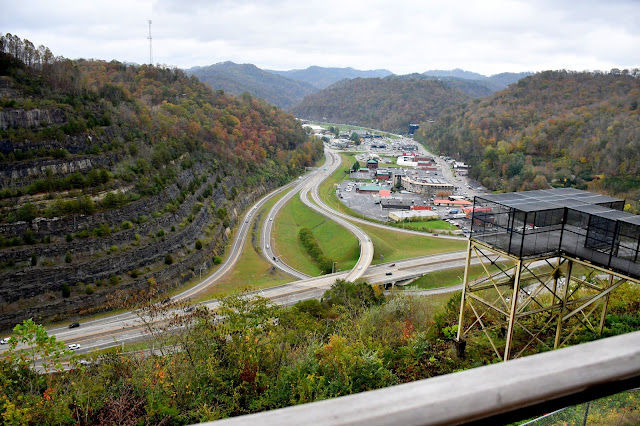
I want to take a moment to wish you and yours a very Happy Holiday season! Thank you for reading my articles and spreading awareness of predicaments and how they're different from problems. In appreciation, I have some special pictures from the Thorny Mountain Fire Tower and Seneca State Forest and Cass Scenic Railroad State Park!




Thanks again, Erik, and a happy holiday season/good times to you and yours, too. Just a short comment here, including agreement and questions. I also have written about getting to the roots of the predicament (which involves a long history of conceptual, cultural, systemic and habitual "wrong turns" and a corresponding sequence of consequences--see, https://learningearthways.net/2025/02/26/natural-consequences-reflections-on-william-r-catton-jr-s-overshoot-and-bottleneck/ for example). Do you perceive that the notion that our species can or will do anything to "resolve" or "fix" Earth overshoot as just another form of hopium? My reading of this post senses that you do. I do not think that we, collectively, or in sufficient numbers will take they only action that could ever reverse the course or momentum of this predicament: putting the brakes on this misconceived, "civilized" "way of life." It would actually take even more than that. We would also have to purge ourselves of the entire set of misconceptions and beliefs that are at the root of what created unsustainable, anti-Earth life civilizations. That, in part is why I only can have hope in efforts by possible small groups of survivors, post-apocalypse, to start over on an eco-centric, ecosystem-led, new path. But if they don't abandon the old conceptual errors and learn to receive Earth's guidance, it can't happen.
ReplyDeleteSo, are our writings and discussions of these matters only potent in as much as they might be acquired somehow by such survivors? Another related thought that I have been working with over the last year or so is, should we spend much more time now listening and taking heed to Earth's non-human voices and messaging than continuing to try to learn what we really need to know from the writings and thoughts of our own long-errant species?
Homo sapiens is not going to change. I think that is a core point that Erik continually and emphatically makes.
DeleteAs for small groups of survivors post-apocalypse, it's hard to see there will be any. From what I have read very little life will survive 3C, much less 4C and that's where we are headed.
So, "post-apocalypse" is actually many millenia in the future and not at all a meaningful concept for humans.
Thanks, George.
DeleteI think that our species is condemned to continue innovating and using technology as long as possible, primarily now because we have painted ourselves into a corner. How can we get clean, potable water today without technology? With nano- and microplastics, PFAS, PFOS, and all the other chemicals in the air, water, and soil, there is effectively no way to rid ourselves of these toxins. So, yes, I agree with you that there is no way to "reverse" course in a timeframe that is relevant to humans and that to think so is just hopium; it is denial or ignorance of reality. I think that some people like you and me are doing what we can, but the greater majority of the global population has little if any real knowledge about overshoot. Degrowth has many proponents, for instance, but is really not much more than a nice reassuring story we tell ourselves. It's similar to taking shorter showers, replacing incandescent or fluorescent bulbs with LEDs, and recycling. They're ALL nice ideas, but none of them or even ALL of them can scale up to what is required because they ALL still require civilization to persist, which just isn't possible.
Quote: "But if they don't abandon the old conceptual errors and learn to receive Earth's guidance, it can't happen."
Exactly. Can we abandon the old systems (civilization especially), conceptual errors, and live in harmony with the rest of life and Earth itself? Can we realize that technology use always comes with long-term negative side effects? Is it possible for our species to learn the illusion of self and separation and the illusion of control? I'm not certain that we can. It does appear with the advent of AI that we are attempting even further control and doubling down on the systems wreaking havoc already instead of abandoning them. We have become so dependent upon these systems of destruction and omnicide that most people cannot see another way forward.
I was reading your blog the other day (the article that you linked to above, as a matter of fact) and really admired the time you've spent accumulating all this knowledge and using that knowledge to push forward in a different way.
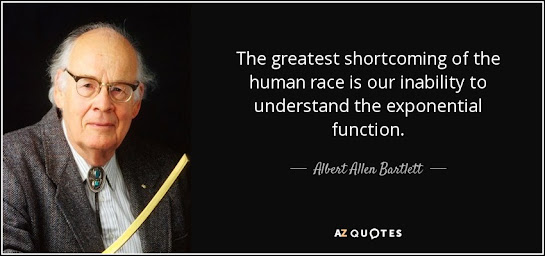
I do think that listening to Earth's non-human voices and messaging is important and probably more accurate than our anthropocentric ideas, although I can't say that either will make much of a difference at this point. Knowing that the ecological collapse currently happening is just in the early stages and that the effects will be exponential rather than linear AND that there is a rather large lag effect and that the system employs a huge amount of inertia moving forward, it's like putting a semi truck in front of a large train expecting the truck to be able to slow the train down.
Speaking of trains, it wasn't until I began going out west into your neck of the woods that I began to appreciate the sheer scale of extraction taking place globally. Seeing the humongously long oil and coal trains snaking their way along the interstates and other highways, understanding the toxic legacy of the Berkeley Pit in Butte, and experiencing the slag pile at Anaconda were a real awakening, and by today's standards, they're rinky dink!
Witnessing the Libby Dam and Lake Koocanusa and getting closer to your neighborhood at the Hungry Horse Dam have also been helpful at understanding the scale of these types of projects out west, something I'm sure you grew up with. Folks out east or even in the Midwest where I live typically are not aware of many of those types of places similar to Lake Mead and the Hoover Dam or Dworshak Reservoir and Dam or Lake Powell and Glen Canyon Dam.
Yes, it's frustrating that so many people just don't get that we have a predicament which can't be avoided. It's equally frustrating that so many people think something can be done for this or that cause (e.g. sea turtles). So long as modern industrial civilisation exists, anything a few humans try to do will be undone because civilisation will eventually try to access resources wherever they are and whatever damage is done to get them, in order to keep this civilisation going a little longer, a civilisation which itself promotes activities which are themselves damaging. In any case, humans have perturbed probably every ecosystem. You can't just help one species, or a few species, in any ecosystem that's been perturbed. The whole ecosystem has to find its own way to a new climax state, whatever that may be.
ReplyDeleteBy the way, I'm not sure what is meant by "reducing overshoot" unless you mean eliminating overshoot.
The reason I use "reducing overshoot" is because that is the best that can be accomplished by our species voluntarily, albeit highly unlikely. I actually think that overshoot will be reduced and eventually eliminated INVOLUNTARILY through collapse and die-off.
DeleteI would go one step further. It is also a "hilarious attempt at command and control" to think we can address overshoot. It is too late for that too. Even if all humans died today, the damage already here (pollution,habitat destruction, greenhouse) will continue to have feedback effects that are causing the sixth mass extinction.
ReplyDeleteWe are in the hospice stage now. Understanding and caring for people and Nature around us is the best we can do. Finding what really matters in life in our final years. Love and compassion.
Greetings, Erik and Anonymous. I didn't get any email notice that you both commented further on this thread, so I am glad that I just checked it out and found your stimulating, provocative thoughts. It is difficult for me and many of my friends, who have been Earth protector activists or "environmentalists" for many decades to fully accept the hopelessness contained within awareness of Earth's grim predicament, as you both also may have experienced, too. But, I have long known, and told others, that in order to move forward most effectively we have to base our analysis, strategy and action on actual scientific reality, even though our knowledge may be incomplete or flawed (acknowledging the "unknowns" and the "mysteries").
ReplyDeleteAnother thing that makes it difficult for me to not yearn for some "hopium," is the fact that my wife and I have eight grandchildren, and so do many other people. (Wisely, knowing what they have learned so far, all seven of our adult grandchildren have decided to not have children themselves.) I've followed the work of Michael Dowd, Guy McPherson, and many other so-called "doomers" for decades and have had more than a few discussions with many of them. I think that most of my long-time activist friends call me a "doomer," but not to my face (usually). I guess that my one little ray of hope or hopium is the idea that ecological collapse on Earth will probably not happen uniformly or completely in every little "nook and cranny," or ecological niche on Earth. There might be little oasis habitats and pockets of survival, though that may be very temporary. There would probably be very few among our own species that know how to live directly in Earth's sustainable, regenerative ways, and any who do know might not end up being fortunate to survive and have access to a remnant, oasis habitat. Then there is the reality that the process of extinctions and further collapse will continue long after the cataclysmic events that shut down human civilization. But, even with all that we now know, there will still be many unknowns, because we are not nearly as "sapien" as we think we are. I am glad that acceptance does not necessarily have to be coupled with inaction.