Stop Making Sense

Whiteface Mountain, New York
Stop Making Sense was a 1984 movie and album featuring the American rock band Talking Heads. It's almost the perfect title (euphemism?) for this article which goes into describing the predicament we face and why we cannot extract ourselves from it. I have written before how our species isn't a rational one, but a rationalizing one, often based on narratives and stories. William E. Rees explains more indepth about why collapse is inevitable (part 2 of a series).
Spending time thinking about what I can write about that will be the most helpful to my readers is a regular occurrence. Telling my story has been helpful to many, according to comments I have received over the years. People tend to notice parallels to their own stories and it helps them to realize that they are not alone.
Reaching acceptance has been difficult because of the tendency to flow back through previous stages of grief. Self-doubt can also be troublesome, as one asks himself or herself if they are making the right move or coming to the correct conclusion about something. I have caught myself bargaining many times. "What if...?" crosses my mind regularly.
At the same time all of this has been going on, the person I am inside has been changing as well, and the outside world has likewise been changing. Many people who I thought were friends are no longer an active part of my life once I realized their personal morals had been compromised for or by their (false) belief in narratives (many political) that I know are nonsensical. Does this sound familiar?
Meanwhile, all the changes I routinely discuss here, generally symptoms of ecological overshoot, are affecting all the systems which surround us and for those who are willing to see them, can themselves often be a source of grief for the losses occurring. I often wonder why so many people find extinction so difficult to accept. It's all around us and yet many people don't appear to comprehend that we're not just talking individual species here and there. We're talking complete ecosystems as Lyle Lewis points out in this recent article, quote:
"We are living through a mass extinction event defined less by the disappearance of individual organisms than by the disappearance of the conditions that allow life to persist at all."
These concepts are extremely important to understand, as they form the basis of our own existence. Without these systems, there is no habitat for us. Many people have this blind faith or belief in a "bottleneck" that they assume humanity will somehow scratch through. I don't see this happening because the systems which support us are being rendered incomplete and this effect will effectively neuter our species (along with millions of other species). Be sure to check out Lyle's example of the vast woodlands which once lined the Missouri River.
"But the same traits that support stability can obscure disruption. Social-conformity bias, optimism bias, normalcy bias, and culturally reinforced worldviews (all well-documented psychological mechanisms) help keep a society together during its growth phase.
They also make it difficult to perceive structural risk, ecological overshoot, or the fragility of a paradigm that has begun to falter.
This is where the inversion emerges. The cognitive style that once served the maintenance of a growth-based civilisation becomes less suited to recognising the limits of that civilisation.
Meanwhile, the perceptual traits often associated with neurodivergence, pattern recognition over social reassurance, systemic perception over short-term reward, and truth orientation over comfort orientation, become increasingly relevant in a world where biophysical reality is asserting itself.
This reflects a change in environmental conditions. A culture built on continuity, stability, and upward trajectories rewarded those who reinforced its narrative.
A culture entering contraction requires something different; an ability to see the cracks in the dominant story, to detect pattern breaks, and to register tipping points, even when they remain socially unacknowledged.
In this light, the apparent mismatch between neurodivergent perception and normative culture looks less like dysfunction and more like early alignment with an emergent reality.
The cognitive minority happens to be tuned to the underlying dynamics sooner - not because of special insight, but because the environment has shifted away from the conditions that shaped the dominant cognitive style.
The result is a hidden but consequential reversal: the minds best suited to maintaining a growth civilisation are maladaptive in recognising its limits.
Both cognitive modes are human - both are valid, and both evolved for different ecological contexts.
But only one of them believes the ship is unsinkable."
"It’s Different This Time — No, It’s Not.
Back to the person inside - the paradigm I once was a part of has disappeared and this article from Ernesto Van Peborgh tells the story. The only improvement I would add to his article would be an acknowledgement of the mass extinction surrounding us, that civilization (modernity) itself is unsustainable, and will likewise be disappearing, and that the reader will need to be mentally prepared for massive loss and change as time moves forward.
Massive loss for the loss of the life one previously led; job loss, loss of discretionary spending, loss of stability, loss of services which have had their funding cut off, and loss of many of the places which once surrounded us. Loss of species due to the mass extinction we are in is yet another tough pill to swallow. Most likely the extinction of our species is also baked in. Here is an article from Dennis Meredith about human extinction from climate change. It's always interesting to me how people can imagine extinction from a symptom predicament of overshoot (such as climate change, collapse, pollution loading, biodiversity decline, energy and resource decline, etc.) but not overshoot itself.
Another interesting detail is how so many people cannot fathom such an occurrence, as if we somehow have magical abilities to create habitat that no other species has. Of course, we don't, but try to get that across to folks and see what they have to say about it. Without the energy and resources to keep civilization humming along, it grinds to a halt (see next paragraph). Even worse, some people think we have some sort of technofix that will allow us to continue civilization long into the future, denying that it has been our behavior of technology use that has caused all the symptom predicaments which indicate overshoot in the first place. No built technology has ever existed that did not magnify the negative impacts caused by technology use, because technology use always leverages more energy and resources to accomplish the tasks it is used for. Take a look at the complexity and complications of just two types of technologies - robots and AI - and see if you can see the implications of where these are taking us, especially the energy and resources required for this technology use to continue.
Last month, I highlighted our addiction to technology use. The above paragraph is instructive as to the simple fact that civilization is unsustainable and can not and will not continue long into the future, and folks who think technology use will continue long into the future are clearly missing the fact that without the energy and resources to keep civilization humming along, most technology use will likewise disappear, as Jeff Gibbs explains. Sadly, I think that even community won't help much. The comforting narrative of becoming a resilient community with your neighbors can only be maintained as long as law and order remain established. As collapse deepens, so too will the veneer and privilege that law and order support and maintain. After that point in time, typical tribalism will re-establish itself at which point groups will be required to repel other groups' raids for food, supplies, and other living necessities.
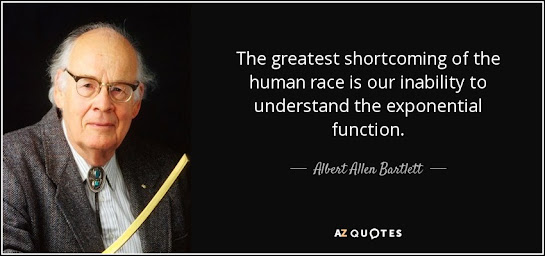
Elisabeth Robson explains in this article why pollution loading will continue to worsen, causing more prevalent disease, and this then will contribute to collapse, reducing complexity which will cause further collapse. Since most people cannot fathom the exponential function, few realize the implications of what this portends for society and civilization. Justin McAffee gives a good rundown here. What happened during the COVID-19 pandemic in 2020 will seem like a carnival in comparison, because this isn't something we can bounce back from like we did back then.
It was the late Michael Dowd who saw my neurodivergence as a strength, and it has indeed allowed me to see all of this so easily when others struggle to accept the situation we find ourselves enmeshed within. For anyone who has ever noticed our abilities of pattern recognition, there is definitely a strong correlation as to why we notice overshoot and collapse earlier than neurotypical individuals, as Adrian Lambert explains here, quote:
They also make it difficult to perceive structural risk, ecological overshoot, or the fragility of a paradigm that has begun to falter.
This is where the inversion emerges. The cognitive style that once served the maintenance of a growth-based civilisation becomes less suited to recognising the limits of that civilisation.
Meanwhile, the perceptual traits often associated with neurodivergence, pattern recognition over social reassurance, systemic perception over short-term reward, and truth orientation over comfort orientation, become increasingly relevant in a world where biophysical reality is asserting itself.
This reflects a change in environmental conditions. A culture built on continuity, stability, and upward trajectories rewarded those who reinforced its narrative.
A culture entering contraction requires something different; an ability to see the cracks in the dominant story, to detect pattern breaks, and to register tipping points, even when they remain socially unacknowledged.
In this light, the apparent mismatch between neurodivergent perception and normative culture looks less like dysfunction and more like early alignment with an emergent reality.
The cognitive minority happens to be tuned to the underlying dynamics sooner - not because of special insight, but because the environment has shifted away from the conditions that shaped the dominant cognitive style.
The result is a hidden but consequential reversal: the minds best suited to maintaining a growth civilisation are maladaptive in recognising its limits.
Both cognitive modes are human - both are valid, and both evolved for different ecological contexts.
But only one of them believes the ship is unsinkable."
I saw a quote from Pema Chodron's book, When Things Fall Apart, the other day that mirrors my assessment that only acceptance and Living Now can provide the peace that we need today:
"Times are difficult globally; awakening is no longer a luxury or an ideal. It’s becoming critical. We don’t need to add more depression, more discouragement, or more anger to what’s already here. It’s becoming essential that we learn how to relate sanely with difficult times. The earth seems to be beseeching us to connect with joy and discover our innermost essence. This is the best way that we can benefit others."
These patterns can be difficult for many people, especially neurotypical types who often disregard messages which appear "too negative" in their minds. A new article from Frank Moone points to how these predicaments we face interact with our psychological, biological, and cultural imperatives to produce the deterministic result of overshoot, quote:
These patterns can be difficult for many people, especially neurotypical types who often disregard messages which appear "too negative" in their minds. A new article from Frank Moone points to how these predicaments we face interact with our psychological, biological, and cultural imperatives to produce the deterministic result of overshoot, quote:
"Political and corporate systems optimize for quarterly returns and election cycles, not long-term survival. This structural bias sacrifices future stability for present gain, ensuring the overshoot persists until nature enforces correction."
I call this the, "Live Now, Pay Later," recipe. Kick the can down the road until we run out of road. I'm used to seeing the exact same narratives over and over again, where we'll "fix" it by doing 'X' if we just start now! Frank goes on to explain that there is no "fixing" this:
Every past civilization that exceeded its ecological base faced contraction. Mesopotamia’s salinized fields, Rome’s deforested hinterlands, the Mayans’ exhausted soils — all attest to the same pattern. Overshoot is an unsolvable predicament. The only unknown is how far down we must fall before a new equilibrium returns."
The Honest Sorcerer explains why logic, reason, and rationality won't bring resolve to what we face. This is another excellent summation of the situation. In it, he mentions dualism, and Tom Murphy has an awesome set of articles regarding this topic here and here and here and here and here and here (so far).
Art Berman adds to the mix about why our so-called "solutions" are doomed to failure. Last but not least in this series of material designed to explain our collective lack of rationality, Mike Joy points to pedagogical tendencies that should be challenged within university education.
While it still bothers me that more people didn't listen to James Hansen back in the late 1980s, this article attempts to make clear why more people didn't and that it's because our species is quite literally unable to function rationally as a species. I understand why so many people hope for a miracle that simply isn't possible, but the facts make clear that no such miracle is in the offing. Before signing off today, and speaking of James Hansen, I recently came across this article explaining his prediction of us hitting +1.7C next year (2027). Brace for impact?
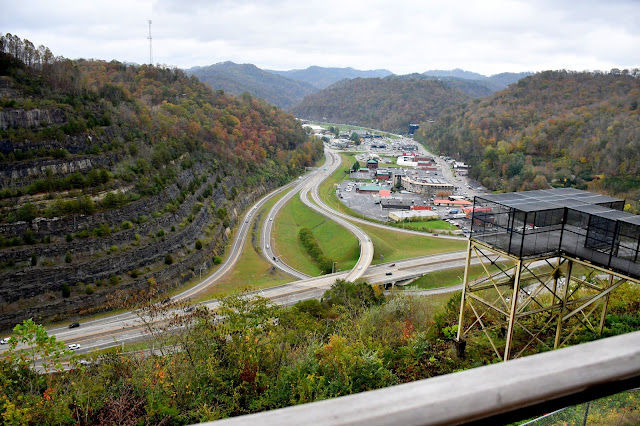
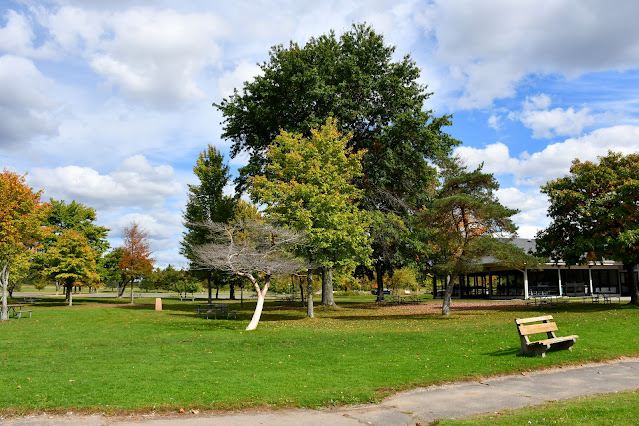
I hope that you are having a great New Year so far and that you have gotten some time to spend outside to enjoy the weather and whatever nature has to offer this time of year. Here are some pictures from The Lowther Store and Wheeler, West Virginia, that I took a little over 3 years ago. Enjoy!





Thanks for the shout-out, Erik! Perhaps more than almost anyone else, you are well aware of the popular resistance to all this. Folks just don't want to accept the ugly truth that's staring them in the face. For you, and me, and many others, the task is to press on! Many thanks for your support and for the amazing body of work you have created!
ReplyDeleteI greatly appreciate your articles for their wisdom, clarity & honesty. Each one is therapy for me. I still aspire to get to much longer periods of acceptance & Live Now. When I read or see of some horrific human action destroying the natural world I sometimes regress to anxiety, worry, sadness & anger. Your articles make sense of it all & give me clarity & peace
ReplyDelete