Our Anthropocentrism and Psychology, Part Two

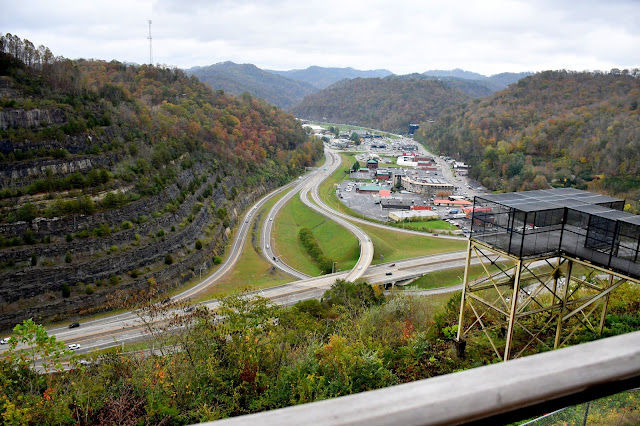
The ongoing construction of US 58 in Virginia near Lovers Leap Overlook
as it looked in May 2025
As I was looking for a picture for this article, I came upon one that truly fits the bill, so to speak. This construction project along US 58 in Virginia is taking an old 2-lane highway that used to wind its way through the mountain here and straightening it out while at the same time turning it into a 4-lane superhighway. Admittedly, the previous highway wasn't a route that would get a person quickly from point A to point B. Then again, anyone traveling this route already knew that, as the road's nickname is The Crooked Road. As is true with most highway routes here in the USA, car culture rules and in many people's minds, the best route from point A to point B is the shortest and easiest route.
When I was in my 20s, that line of thinking worked just fine for me too. However, there were a few times where I began to realize that one could see much more by taking older routes that were slower by necessity in many cases, and because one can't drive 60 or 70 or 80 MPH on these roads, one naturally gets to see more of what's along each one. Today, on my trips, I spend a considerable amount of time driving what most people would call "back roads," older highways and routes that most people avoid because there's no reason for them to spend more time driving than they have to. Of course, in my case, I'm driving them for the scenery and just for the fun of it on my trips.
The newer routes do get one to their destination quicker with fewer elevation changes or at least a more gradual grade, less curves, and the ability to pass slower drivers. But they also bypass some of the things that made the old routes so special. I've spent a great deal of time checking out these older routes because of the history associated with each one, and I'm rarely disappointed.
Needless to say, I have always been fascinated by routes of travel - roads, railroads, and canals and other waterways, the roads of the past. The first time I visited Yellowstone NP, I remember thinking to myself, "I wonder why they didn't build a 4-lane highway to get to it?" I didn't know anything about Jevons paradox back then, but now I realize that building such a road to get there would most likely require many upgrades on the roads in the park itself, potentially requiring 4-lane highways inside of the park, reducing the natural appearance of "emptiness" and the "wildness" of it all. Building a 4-lane highway through Yellowstone would set an ugly precedent for other national parks and turn the experiences into more commercialized and industrialized versions of what they are today.
This brings me to the concept of emptiness. We like to think each time we find a special place that is "empty" that we discovered it. But did we? The reality is that it's highly unlikely. In an article by The Ecosocialist, he points out wetiko, a topic I bring up regularly:
It appears empty because the forms of life inhabiting it are not recognized as legitimate. Their relationships to the land are not recognized as forms of ownership. Their use of it does not count as improvement. Their societies do not count as civilization. Sometimes their lives do not even count as presence.
This is why the colonial imagination so often begins by producing vacancy. Land must become available in thought before it can be taken in practice. It must be described as wild, barren, wasted, underused, dangerous or waiting. Its inhabitants must be turned into nomads without property, savages without history, squatters without title, obstacles to progress, threats to nature or bodies out of place.
Only then can occupation be narrated as discovery, enclosure as protection, expulsion as conservation, and colonial settlement as redemption.
The very language of “discovery” already performs an erasure: to “discover” a land is to imagine that its history begins only when it enters the maps, archives and systems of possession of the colonizer. From the perspective of the peoples who had inhabited the Americas for millennia, the “discovery of America” is a contradiction in terms. What was new to Europe was neither unknown nor uninhabited; it could appear as a new world only by denying the knowledge, memory and sovereignty of those who already lived there."
While I have previously attempted to highlight the nature of our anthropocentrism and psychology by showing the illusion of self and separation (in reality, we are actually connected to everything else in the universe, so there is no separation except for in our minds), along with many of the phenomena I've been writing about over the past month or two, I still think more attention should be given to how nature and the world really work versus how humans often tend to think they do.
A recent article from Lyle Lewis does exactly that - it shows us the difference between conservation narratives that are easily seen and recognized and ones that are more or less "invisible," caused by invasive species which ecologically change how the systems that surround them work, quote:
"This is not a critique of wolves but a recognition of how we see. Humans are drawn to presence, but often struggle to recognize absence. We see wolves returning to the landscape, but do not see native cutthroat trout being replaced by a very different predator beneath the surface.
We see animals moving through valleys. We do not see connections breaking between lakes, streams, and the surrounding landscape. We tend to build our understanding of ecosystems around what is most visible, most intuitive, and most easily explained. What happens out of sight is harder to hold.
Ecosystems are not organized around presence alone. They are organized around connection. When those connections are altered — whether by the removal of a predator or the collapse of a fish population — the effects do not remain isolated. They move. They accumulate. They reshape ecosystems in ways that are not always immediately apparent."
We see animals moving through valleys. We do not see connections breaking between lakes, streams, and the surrounding landscape. We tend to build our understanding of ecosystems around what is most visible, most intuitive, and most easily explained. What happens out of sight is harder to hold.
Ecosystems are not organized around presence alone. They are organized around connection. When those connections are altered — whether by the removal of a predator or the collapse of a fish population — the effects do not remain isolated. They move. They accumulate. They reshape ecosystems in ways that are not always immediately apparent."
So frequently I see narratives of "restoration" of nature; a forest replanted, a desert "greened," soil rebuilt, species "saved," and on and on. But as Lyle showed us above, most if not all of these claims are only partially correct and leave out important pieces of information that indicate all this "restoration, greening of deserts, and species saved" is only temporary. Once the energy and resources to actually make these ideas work in the first place and then maintain them is no longer available, guess what happens to those ideas? As Dave Pollard explains here, those systems collapse. Similarly, many different narratives on climate change, energy and resource decline, and pollution loading often point the finger of blame on a particular issue, economic system, or government as being the "problem" that needs to be changed or done away with when in reality it is the overall structural system of civilization (modernity) and our behavior of technology use which civilization is built upon that creates the predicament of overshoot that we are all suffering from. How we power it, what economic system we utilize to trade with, and how we govern it are all irrelevant.
Many people who focus on climate change and emissions in particular often cite "renewable, green, clean energy" in the form of electricity as a "solution" for climate change and blame fossil fuels as the "problem." This is reductionistic thinking which avoids the complexity of the issue. The truth is that the real issue is structural in nature - it is civilization itself - and our behavior of technology use (which is what supports civilization in the first place) that is to blame. Technology use is what required fossil fuels to begin with. When we were hunter/gatherers, fossil fuels weren't required because we weren't living in cities, driving cars, and using electronics. Needless to say, electrifying everything changes nothing - the underlying system of civilization will keep on producing the same impacts regardless of how it is powered. The Romans, Puebloans, Hopi, Mayans, Chinese, Cahokians, and every other organized society based on civilization all collapsed long before fossil fuels or electricity were in use.
A new article from Resilience shows us how the largest mass extinction that ever happened on this planet is what we are heading towards and how the overall size isn't as important as the rate of change. One would think that the warning that this gives us should have folks greatly concerned, and yet most people ignore it as unimportant because they don't understand overshoot. An extremely poignant video highlights precisely why this matters. The video is about bears and hiking, which might seem to have no connection to what I'm trying to point out here, but once you discover how the landscape is changing beneath our feet, how bears are changing their behavior, and how we aren't; you can see how the same scenario metaphorically is changing surrounding the whole issue of overshoot. Because even the symptom predicaments of overshoot are hyperobjects, their complexity escapes most folks, including many of the scientists who study those symptom predicaments. Because we all suffer from blind spots, that fact only adds to the misunderstanding of those predicaments, no differently than how the misunderstanding of bears can likewise lead to disaster. For us, with regard to overshoot, the eventual outcome should be clear to see.
I recently came across the Birthstrike Movement. Before pollution loading became such a grave concern, a movement like this could be seen as a positive development. While it can still be seen that way, one can also now see why it may be a moot point. With spermageddon on the horizon, such a movement may likely become involuntary. Like so many of these other ideas regarding "solutions," they're all basically the same - bargaining - in an effort to continue civilization.
I see this same bargaining time and again in almost every idea brought to the forefront as a means to "save the world," even ideas that are good ideas to implement. While some ideas actually contain some great elements, all them incoporate magical thinking into their appeal. The bottom line is this - until the unsustainable system of civilization is done away with (and this will happen voluntarily or involuntarily), all of the ideas that actually can be beneficial still won't accomplish much if anything. For instance, the idea of degrowth can be beneficial if the target is to reduce our behavior of technology use. But with the idea mainly being that we can continue civilization with just a smaller amount of consumption, the people invested in such an idea are using reductionist thinking and not seeing (among other issues) the self-reinforcing feedback loops that continuing to rely on civilization (and therefore modern technology use) produces. The energy and resources simply do not exist to continue civilization as it is today, which is why it will contract and eventually cease to exist. This is why degrowth as it is today will not work.
I find it exceedingly sad that I even need to put a part in this article about doomism, but there are particular psychological qualities about it that should be pointed out. I have previously written about several notable scientists/authors who continue to spout complete nonsense about doomers and/or doomism. Eliot Jacobson said it better than I can probably muster, but it's important to highlight the toxic positivity element that Michael Mann, Hannah Ritchie, Zeke Hausfather, Katharine Hayhoe, Genevieve Guenther, and so many others too numerous to mention continue to spew. A member in one of the groups I run asked this question:
My comment:
I frequently ask myself that same question. But hey, let's buildout AI, a technology to compute faster than any human can think using MASSIVE amounts of this finite store of energy (not to mention the resources in terms of extracted materials) so that it depletes everything even FASTER! How brilliant is this?!!
Then again, this is who and what we are as a species. How many people saw these same qualities as Rome collapsed? Those who think we are too intelligent to "allow" this to happen apparently don't look at the historical evidence much. To be able to see these hypocrisies is quite interesting, I must admit. The fact that it is also highly depressing makes it a low-quality form of entertainment."
Well, I must admit that despite my interest in overshoot and the predicaments and problems underneath its umbrella, I still enjoy things like mountains and hiking even more. I need to clarify that my opinion of those hypocrisies making it low-quality entertainment is based upon the fact that despite them being interesting, it isn't necessarily something I want to see. It is no different than my opinion regarding overshoot in general - I don't like the implications of what I know about it. I do talk about it, but not because I actually like it; I simply think that others deserve to know what is coming down the pike. This really is now the sole motivation I continue publishing these articles.
I have already finished a third installment in this series, which will be published Wednesday, September 2, which, for now, will conclude this series. Next week I will have a new article titled, Natural Wonders and More Narratives, which I am especially proud of. I hope you will find it enlightening, inspiring, and despite the subject material, relaxing. Until then, Live Now!





Comments
Post a Comment