Natural Wonders and More Narratives

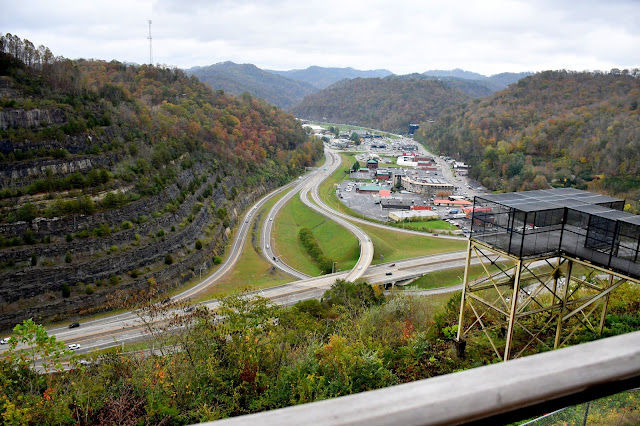
Lovers Leap Overlook, Virginia
I've spent a great deal of time over the past couple of years promoting getting out and enjoying nature through posting lots of pictures from various trips on the Treasured Traditions site (each week a new set of pictures is posted on the site and I share them on posts made here at the end of each post). I figure that if I help a few people develop more of a love for nature and improve their relationship with nature, then those people will likewise share their love of nature with others and perhaps help inspire others to do the same.
Over the Independence Day Holiday weekend, ABC aired "7 Natural Wonders of America" which showed 6 (out of the 7) places I've been to and thoroughly enjoyed each time I was at each location. Most of them I have been to at least twice and some of them I have been to multiple times. To be completely fair and honest, there are so many different parks and natural wonders in the U.S. that focusing on only 7 seems rather simplistic. I often forget just how many state and national parks, monuments, wildlife reserves, forests, and other special places that I have been to over the years, but it seems to me that keeping this to just 7 is quite limiting in scope. Still, I'm appreciative of the coverage of these 7 special places which might inspire adventurous folks like me to partake in visiting:
Why do I think spending time in nature is so important? Because nature is disappearing. Last month I revealed the reason I finally quit procrastinating a trip to Alaska I had dreamt about for more than two decades. My original dream of going to Alaska came from a documentary about the building of the Alaska Highway, known back then as the Alcan Highway (Alaska-Canada). I finally came to the realization that seeing Alaska as it was then was going to disappear and that no amount of money could get it back. It became quite clear what was more important, and money wasn't it.
Oh, sure, nature itself will always exist. But the species of flora and fauna that exist today are disappearing, and just like I discovered about Alaska, ignore what exists today and it might go away while one is busy doing something else. After my trip in May, I spoke about how the campsites were quieter than they had been in recent years. Sadly, there is actually evidence of this phenomenon. It's not just about species disappearing, either. It is entirely possible that the collapse we will experience over the next year or two due to the Iran War will prevent most people from having the ability to travel to these places (the Alaska Trip alone was over 11,000 miles).
Just recently I brought up a post I made earlier this year about opting out and walking away and I just came across this post quoted below which describes one particular part of what my posts (Part 1 is the initial article and Part 2 discusses eremition) are about:
A full pantry. Healthy children. A roof that did not leak. A husband who came home. A garden that produced. A few good dresses. A reliable stove. Sunday dinner with people she loved. Enough flour for the week and enough kindness for the neighbors.
That was the whole dream. That was the whole life. And by the standards of most of human history, achieving that list was a roaring success.
Then the twentieth century happened, and somebody figured out that a woman who is content is terrible for business. A woman with a full pantry is not running to the store. A woman who is satisfied with her kitchen is not redoing it every four years. A woman who knows what enough looks like cannot be sold the next thing.
So they got to work. They made the small house embarrassing. They made the old car embarrassing. They made the home-cooked meal embarrassing, and then when nobody knew how to cook anymore, they sold it back as a meal kit with a celebrity chef on the box. They raised the cost of living until both parents had to work, and then they sold daycare and convenience food and weekend therapy to fix the exhaustion that working both jobs created in the first place.
They took your great-grandmother's list and called it poverty. They took her life and called it limited. They took her contentment and called it a lack of ambition.
And then they sold you ambition. They sold you a bigger house you cannot clean, a car you cannot pay off, a wardrobe you do not wear, a calendar you cannot survive, and a vague constant feeling that you are still falling behind.
You are not falling behind. You are running a race that was designed to have no finish line. The race itself is the product.
Go back and read her list.”
The author is listed as "unknown." Still, this is very good as it points out how the average Joe has basically more or less been told that he has halitosis and that he needs to use Listerine mouthwash to eliminate it. What did people use before Listerine was invented? How about the thousands of other products that didn't exist before the 20th century?
While writing this, I came upon an interesting article on the Resilience site, one condemning capitalism. The article correctly points out many facts, such as our ability to cooperate and that groups that cooperate generally beat out individualists or groups in competition with one another. I think that it paints capitalism as being bad - as if capitalism was created by something other than humans. But the part that really got me was the part where the author appears to confuse capitalism as being totally separate from civilization even though it is but a part of civilization, quote:
"The élites are as determined as ever to hold onto their power and wealth, but ordinary people are hungry for change.
For 500 years, we have been led to believe that capitalism is the only kind of economy that works. But it is not working. Its leaders are destroying nature, causing climate chaos, undermining communities, and creating loneliness, all in the name of selfish capital gain. If that is “working”, we need something better.
We can find it in the economics of kindness, which takes the golden thread of cooperation and uses it to weave a new economy based on mutual respect and working together, without domination by others."
Guy Dauncey appears to think that the economy and its leaders are destroying nature, causing climate chaos, undermining communities, and creating loneliness. In actuality, industrial civilization (or modernity) is what is causing all of that and more. In other words, we are doing this. "The economy" is nothing more than just a part of civilization. Switch out a different economy for the existing one and what do you get? It's not one bit different than carbon tunnel vision - switch out coal-burning power stations for wind turbines and solar panels and batteries and what changes? Essentially nothing, because fossil fuels and the fossil fuel platform are still required to continue civilization. The essential services that fossil fuels provide would still be required to continue mining, building wind turbines, solar panels, and batteries, and maintaining everything including the electrical grid and our road networks to transport all of that equipment. The only way to maintain industrial civilization is with fossil fuels. Give them up and the world returns to what it was 3 centuries ago, including the global population of around 700-750 miliion people.
Once again, this is reductionistic thinking that achieves nothing. To be sure, Dauncey is self-described as a utopian. I chuckled as I went to his website and noticed that he talks about "stopping" climate change, where I wisely chose to stop wasting time reading any further. He suffers from false beliefs over proven facts, no differently than so many other people. I realize that very few want to understand the truth. It isn't pretty and nice. But the facts aren't going to change, so why spend one's life living in fantasyworld?
One of the best recent articles I've come across is this one from Tom Murphy for the honest truth about civilization (modernity):
Modernity is a package deal. Pick your favorite aspects of modernity—medical care, low infant mortality, thermal comfort, grocery stores, etc.—and you’ll find it inseparably hitched to a sixth mass extinction. The universe simply does not care if you can manage to separate the phenomena in your puny head. Of course you can. Big whoop.
At some level, any hopes I might have for the future are almost as pointless as my wishing that modernity had never been initiated (largely by agriculture, 10,000 years ago). Despite this, being human, I do have wishes and hopes swirling in my meat brain."
So, civilization is a package deal - it comes with extinction. What Guy Dauncey and countless others want is to "solve" climate change (and all the other symptom predicaments of overshoot, including overshoot itself) and continue civilization as is. Only trouble is, that particular desire equals our extinction. I don't see another option since switching out economic systems doesn't really alter our living arrangements - as long as the system depends upon technology use as the means to provide everything for us, effectively nothing changes. Money isn't a natural resource nor does it provide sustenance nor ecosystem services. Its value is based upon one's belief that it has value - it has no real intrinsic value in and of itself. Steve Bull explains in a more detailed manner in this article:
"With this foundation in place, Part 2 traces the dynamic consequences of these structures as they collide with biophysical limits. Four interconnected feedback loops show how the symbiotic trap of state-backed credit creation operates in motion: debt driving low-EROI extraction, falling net energy trapping monetary policy, ecological overshoot destroying financial collateral, and technological complexity becoming unserviceable. The analysis then broadens to examine the deeper historical and ontological dimensions of our predicament — exploring money as a technology of representation, the pre-market precedents of currency debasement, and the distinction between capitalism as a symptom versus the growth imperative as the underlying disease. Finally, the conclusion addresses the boundary conditions of our predicament, the likely behaviour of the ruling elite as consequences become increasingly apparent, and the question of whether any technological breakthrough — including “clean” or infinite energy — could alter the trajectory, concluding that the problem is not the source of energy but the structure that demands its continuous expansion."
Another section explains capitalism further:
However, it would be wrong to conclude that capitalism is the root cause. As the historical examples above illustrate, the pattern of expansion, resource drawdown, diminishing returns on complexity, and collapse predates capitalism by millennia. The Inca, the Roman Empire, the Maya, and dynastic China all overshot their ecological bases without a single share of stock or fiat currency. The underlying driver is not an ideology but a biophysical reality: complex societies require continuous energy input to maintain their organisation, and that requirement drives expansion until it hits limits.
Capitalism is the most potent expression of this pattern to date — an extraordinary amplifier of the human tendency to maximise power throughput. But it is a symptom, not the disease. If capitalism vanished tomorrow and were replaced by a socialist or communist system that also demanded perpetual growth in GDP and energy throughput, we would still face the same thermodynamic constraints.
The implication is humbling. No political system can escape the Second Law of Thermodynamics. The problem is not capitalism alone; it is the civilisational project of endless expansion on a finite planet. Confronting this requires not just a new economics, but a new ontology — a different way of understanding value, progress, and our relationship to the biosphere."
Steve has explained in other previous articles the lunacy of thinking that "renewable" energy can be of any use to civilization beyond the illusion that it presents, but Balázs Matics (The Honest Sorcerer) explains here how not only will we not be mining with "renewable" energy, but pretty much all modern technology will cease to exist by the end of this century, quote:
"Once large scale coal and oil extraction will be gone, though, our descendants will be forced to return to burning charcoal to process the scrap metals left behind by us. This would not only mean rapid deforestation but also a drastic drop in metal production and recycling. As a result more than 90% of the materials currently in circulation today could be lost during the long descent of modernity, as we will most likely lack the capacity and energy needed to process them. Most of our metals will simply be left to rot and rust where they are. And as we have already depleted all easy to access high grade ores (amenable to artisan mining and smelting techniques) our descendants far into the future will eventually have nothing to extract from Earth—surely not with a pickax and ox-drawn carts. We will thus first see the emergence of a vibrant scavenger economy, salvaging and repurposing whatever they can as modernity starts to break down, then as we lose metallurgy due to the lack of energy to power it, our late descendants will witness the complete loss of all our present day modern technologies. Sure, they will have an odd blacksmith here and there, but that’s about it."
I understand that this is a harsh reality. When I began to understand all of this myself, it felt like the floor underneath me was falling away. It seemed like everything around me was based on illusion, and in a very real sense, it was. Society at large has been led to believe that civilization is sustainable and that infinite growth on a finite planet is possible. Neither is true, so most all of us bought into what amounts to a giant Ponzi scheme. It's a hard pill to swallow. Kathi Irwin brings us back to earth in a rather humbling article which can be condensed into this part:
Writing that sentence is like promising to enjoy a meal after you’ve swallowed it.
Maybe wisdom isn’t learning where we’re going.
Maybe it’s finally accepting that we’ve known the destination all along."
This brings us back to our relationship with nature. Once again, we discover that Living Now is all we have. If we try to live in the future or the past, we miss the now; the present. Keep it real with the cycle of life.
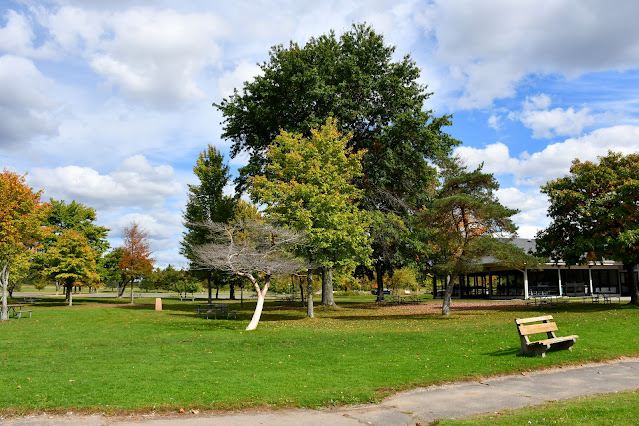
For today I have Locust Springs Picnic Area, a place that I discovered needed some pretty serious work, and East Fork Campground, located in Durbin, West Virginia.





Comments
Post a Comment