Questions Regarding Collapse Response Behaviors

Historic Jacks Creek Covered Bridge near Woolwine, Virginia
This article starts out inspired by one of Dave Pollard's articles about Roger Hallam and the Four Fractures of Collapse. I found it quite interesting in explaining how human behavior will unfold as collapse deepens, and I found myself agreeing with three of the quadrants; the ones labeled Biophilist, Opportunistic, and Self-Destructive. I find the other quadrant doesn't fit well with my sensibilities, but can see how all four apply rather well with society overall. Here's the representation:

I have found Stoicism a beneficial way to apply logic to life in general, although I think people generally will respond how they've been conditioned to respond. I find the determinist label probably applies most to me, as we lack agency for going very far beyond what is determined by our biology and psychological conditioning. I think it is a good exercise to actually consider all of this as we begin to seriously slide down the Seneca Cliff.
I don't see humans from a general perspective in this chart - there are folks who fit in all four categories, meaning that certain types are a certain way. In other words, I can't say that humans are naturally sinful and untrustworthy, although many operate in this category on a routine basis. I also can't say that humans are naturally "good" and trustworthy although most operate in that category. It really depends on the person, their ethics, and the situation they are faced with. Some people may label a particular behavior or action as sinful or untrustworthy when at the time a person conducted himself or herself that way, it made perfect sense to them and he or she wasn't attempting to be "evil". Collapse is going to bring many negatives to the surface, so this is why this is such a good exercise to think about the situation before us.
So many people find the things going on around the world completely outrageous, and while I can agree with that sense, as it angers me too; I also see little point in getting triggered by it all. Perhaps the only benefit in that is that it stirs me to write about it.
One item in particular that was mentioned in the article and Dave's response to it really hit the nail on the head, quote:
"And I agree completely with Roger that what we are likely to see in the coming decades of chaos and collapse is an increasingly frenzied struggle between these four ‘fractures’ — not an ideological one (I really don’t think elections are going to make any significant difference going forward, if they even do now). But rather, a clash of behaviours — fascistic militias, Epstein Class hoarders building walls (not just physical ones) to keep the rabble out, depressives who might decide to blow up much more than just themselves, and altruists (like Roger) who will keep organizing and perpetuating small ‘revolutions’ to try to make the world a better place for all, even if he thinks it’s hopeless."
The part about elections gave me chuckle since I routinely see people yammering on about voting in Democrats or Republicans or Independents or this candidate or that candidate. Sure, we like certain candidates because we can identify with some of their claims and platforms. But the system is rigged folks. The table is tilted. Some positive things might get pushed through, but ultimately, political chicanery isn't going stop collapse. Politicians here in the USA are part of the oligarchy, so they are limited by what the corporations are willing to tolerate. Anything they don't like will be dealt with and done away with, one way or another. Many other countries operate more or less this way as well. The social fabric is going to be ripped and torn regardless of politics simply because the energy and resources needed to maintain today's complexities are going to be constrained and not enough will be available to go around.
The part about elections gave me chuckle since I routinely see people yammering on about voting in Democrats or Republicans or Independents or this candidate or that candidate. Sure, we like certain candidates because we can identify with some of their claims and platforms. But the system is rigged folks. The table is tilted. Some positive things might get pushed through, but ultimately, political chicanery isn't going stop collapse. Politicians here in the USA are part of the oligarchy, so they are limited by what the corporations are willing to tolerate. Anything they don't like will be dealt with and done away with, one way or another. Many other countries operate more or less this way as well. The social fabric is going to be ripped and torn regardless of politics simply because the energy and resources needed to maintain today's complexities are going to be constrained and not enough will be available to go around.
None of these realities are pleasant. Knowing all of this doesn't make any of it "better" in any way, but at least those of us in the overshoot community understand that this is what is coming down the pike and won't be caught completely off-guard by any of it. We'll still get upset. The behaviors listed above will still happen. Collapse will continue to unfold and deepen. Life will go on until it can't, and then it won't. That sounds so cut and dried, but it rings true.
The topic of collapse wouldn't be complete without discussion of how we are trapped with the prison bars of civilization, and how rarely they are even seen, let alone recognized for what they are. Tom Murphy has an article that details this same principle with regard to tenured professors in academic positions, which explains rather well the siloed folks who remain overshoot and/or energy blind (see the paragraph regarding Eliot Jacobson's article about doomers and doomism) which explains why so many (people including professors) talk about climate action without realizing that as long as overshoot isn't what is dealt with, carbon emissions tunnel vision won't help.
Related to all of this was a topic posted in a Stoicism group I am part of. The post spurred a question in my mind which led me to post it in my own group and I think it deserves more attention than most folks would probably give it. Of course, I think that about all topics overshoot-related, but this one served up a special focus for me. Here is the post:
-- Epictetus
If human beings truly understood the difference between good and evil in the deep Stoic sense — not just intellectually, but with full moral clarity — they would not choose evil. The Stoics are adamant on this point: no one who genuinely knows the good ever chooses its opposite.
The post can be seen for the truth it dispenses, as on the surface, it seems self-evident. The question in my mind had to do with psychopathies - specifically billionaires with the dark triad and dark tetrad (see here also) qualities - and what the Stoics would think of them. People with these qualities previously (before civilization) had those qualities muted by the fact that they previously would be separated from their tribe in one way or another. This would have had serious consequences to the individual back in those days, as their own survival may have been at stake had they allowed those mental qualities to come to light.
Nowadays, because of the illusion of self and separation, most people see little or no consequences to allowing these traits out in the open. Despite the negative qualities of these psychopathies, if you are a billionaire, what consequences are there? My readers are well aware that overshoot will act as the great equalizer; as collapse unfolds, the benefits of having untolds amount of wealth and power will likewise collapse and once technology use is reduced by nature (civilizational collapse will neuter most modern technologies), billionaires will cease to exist.
Going back to the qualities of good and evil, most people who don't suffer from dark triad or dark tetrad psychological qualities can easily determine the difference between them and the post remains true. However, just like most things in the shadow of overshoot, looking at almost anything and saying that it is either one way or another tends to form a false dichotomy in the presence of complexity. As collapse deepens, issues surrounding the concept of survival will test people's resolve regarding morality, and therefore, the space between good and evil will become more cloudy. For instance, did the members of the Donner Party see murder and cannibalism as something evil or more along the lines of "necessary?" Notice how once an individual or group becomes separated from civilization, the rules or norms of behavior change or disappear depending upon the circumstances.
Another way the difference between good and evil isn't quite so clear appears once one removes the rose-colored glasses of civilization and sees things from a more natural perspective. Is it still considered "good" to engage in the same activities seen today as good? If one looks at how wild animals behave when conditions aren't so great such as killing or eating their young, they often do things we would associate with "evil" even though in those circumstances it would appear necessary from the animal's perspective, most likely no differently than with us.
How about the process of extraction? Does extraction appear to be good or evil depending upon what is being extracted? Is it good for humans but evil for all other species? Or is it evil regardless of what is being extracted? For instance, the extraction fossil fuels has allowed the industrial revolution to happen and this includes all of our modern technologies such as plumbing and indoor showers, toilets, and sinks, modern electrical fixtures and equipment, modern computers, smartphones, and other electronics, and all of our modern heating, cooling, and ventilation technologies allowing unprecedented comfort. Is this good or evil? Or does it exist somewhere between those two extremes? What about the extraction of wealth from the former middle class society of civilization? From my perspective, this is clearly more evil than the extraction of fossil fuels, but knowing what I know about overshoot and how societies operate, was any other outcome truly possible? So then, does this make extraction of fossil fuels more evil than seen before in the first example?
After thinking about this, does all of this cast a different light onto technology and what it has allowed us to do? There are so many things I have learned as part of my passion to understand overshoot. Many of them, like this topic we are exploring, are multi-faceted and difficult topics. What I've discovered is that most of them have both bright and dark sides to them, and they frequently show humans in an unflattering light.
"Forgive yourself for not knowing earlier what only time could teach."
~ Unkown author
Distilling this down further, some things simply cannot be taught - only experience and maturity can bring about their reality. Back when I first watched Michael Ruppert's Collapse, I still believed symptom predicaments like climate change to be solvable "problems" and the documentary he starred in was my first exposure to ecological overshoot. For the first time, I saw and heard what a predicament (actually, a symptom predicament; peak oil in this case, what I frequently label as "energy and resource decline") was, but had no idea what the outcome would be. If you haven't yet seen this documentary, watch it now. It blew my mind back then, and it is still a powerful movie. I watched the movie and it did promulgate some interesting conversations, and then after a couple of weeks, I returned to "regular" life at the time and began getting more active in a climate change group I was in. Outside of that, very little changed in my life.
It wasn't until I discovered NTHE in that same climate group that much changed. At the time, I had no idea what NTHE even was, so I Googled it and came across Dave Pollard's site. What popped up was information (I think it was a short article and an interview Dave did with Carolyn Baker) which led me to Guy McPherson. I later watched a presentation from McPherson at an Indiana university which led me down the rabbit hole. I've been researching ever since then.
We've passed so many peaks since those times. Now come the consequences. I wrote above that "civilizational collapse will neuter most modern technologies." Many people don't understand that the complexity of civilization rests upon several foundations and that those foundations are becoming less and less secure. Most of us have experienced a power outage over the past decade or two and realize what happens when there is no power - many other features of modernity also collapse without electricity. I explained how different layers of technology are built on top of one another in my article about infrastructure, and how when a supporting layer is removed, it topples all layers above it. I have also written about Ronald Wright and "progress traps," and a new article from Balázs Matics (The Honest Sorcerer) includes a wealth of information regarding them as seen here:
He further explains the reality here by pointing out how without the bottom part of the foundation, the entire tower crashes down upon itself:
Never before in human history have so many people gone through their period of energy-intensive economic development simultaneously. Rearranging the deck chairs did not reduce our vulnerability, though. In fact, it only amplified it by accelerating the draw down of resources. So did the adoption of all those ‘alternative’ energy technologies… The progress trap is still there, it just got a whole lot bigger. See, should for example coal production collapse worldwide, it would then seriously threaten the viability of not just coal-fired power plants but other energy technologies as well. Think: oil wells, rigs and drill pipes, or massive concrete foundations and towers for wind turbines; both built from steel and cement and made available in such large quantities (and at such a low cost) by coal.
Wind turbines and pump-jacks are ‘energy extraction machines’ built on mountains of coal, which in turn is mined and transported by diesel engines (also made of steel). And while its true that the sun and the wind are practically inexhaustible sources of ‘free’ energy, the technologies required to build the necessary equipment harvesting it cannot be built by intermittent and diffuse “renewable” energy at scale. Despite all the hand waving, high heat and carbon atoms remains essential in the many material transformations needed to make solar panels, batteries, and wind turbines—and not the other way around. Instead of replacing each other, these energy technologies thus ended up being stacked up on one another in a massive Jenga tower, where every new energy source builds on the continued (and ever growing) extraction of the previous one. Should this cycle be interrupted at the base, the whole tower would come crumbling down."
Before closing here, let's go back to the human behaviors as collapse unfolds. One of the behaviors listed is resorting to religion and/or salvation. This ties in with the topic of hope. I have written quite a bit about hope and hopium, primarily about the tendency of hope to chain a person to the same system that most people hope will somehow magically change. Lots of people "hope" that technology will change civilization so that civilization can become sustainable, like an "ecocivilization." Of course, anyone who genuinely understands the system of civilization realizes that ecocivilization is an oxymoron which cannot exist in reality. Sadly, this is the same as the passage above, "no one who genuinely knows the good ever chooses its opposite." Both are true, but how many people genuinely understand or know? It seems clear to me that there are some who know one or the other, some who know neither, and some who know both. Apparently, that is not enough to dispel either those who choose the opposite of good or believing in ecocivilization. Still, hope is that last bastion for some people who likewise don't understand what hope essentially is.
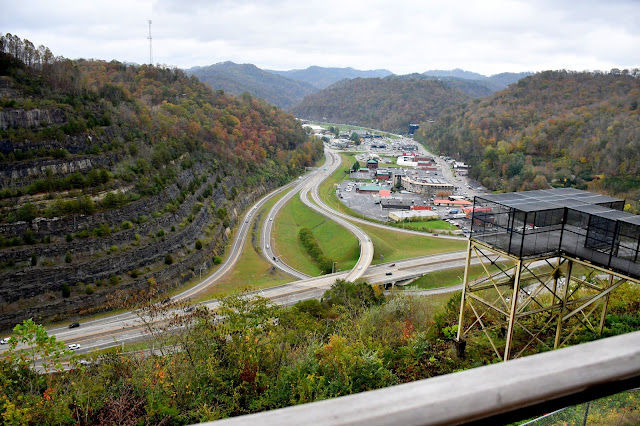
As usual, I have my two entries for you peruse; today's are Mount Storm Scenic Overlook and Skyline Overlook. Until next time, enjoy!






Comments
Post a Comment