Our Wile E. Coyote Moment

Middle Fork Falls, Joyner, Tennessee
Some material has kept being postponed which I meant to get out earlier, but it didn't really fit in with the themes of earlier articles. In fact, I'm way ahead of myself here, writing this at the beginning of February. But at least I can get this posted to point out how things are moving along much quicker these days and that my last several posts have been right in line with these new developments. It really is important that folks understand the necessity of acceptance of the predicaments we face, that they comprehend that these are, indeed, predicaments and not problems, and that the outcomes are not "solutions" for crying out loud.
I've spent the last several months reading other people's articles to gauge where they are along in their acceptance (or not) of what we face. Some are really trying and coming close to full acceptance. Then, there are others who are so far out there that they simply can't be helped. I'm glad I took the time to read what I did. Time keeps getting shorter and shorter to the point where denial will be much more difficult to continue (and yes, there were still a few articles where denial was clearly still happening). I think that this time next year we'll be having a different conversation (if I'm still able to write and/or post these).
Right now, I want to highlight a post I saw the other day by Steven McSweeny:
It comes when I imagine heat that doesn’t break at night, coastlines quietly erased, harvests failing in ways that don’t make headlines until they become famines.
Layered over this is the drumbeat of geopolitical fracture: borders hardening, weapons multiplying, authoritarianism sold as stability in a world that feels unmoored. The dread is not abstract. It is bodily. A tightness in the chest that asks a simple question no one seems eager to answer: if we know this is coming, why are we acting as though it isn’t?
What unsettles me most is not denial, which at least has the decency to be loud, but normalcy. People go to work, plan weddings, argue about prestige television, as if the house were not already warm with smoke.
Our institutions, especially economic ones, insist on business as usual with a kind of manic cheer. Growth must continue. Markets must be soothed. Tomorrow will look like today, just with better apps. Liberalism, in its most comfortable form, promises that incremental reforms and good intentions will somehow outpace physics and history. It asks us to believe that the same system that brought us to the edge will, if gently nudged, pull us back.
But the math doesn’t work. Capitalism requires endless expansion on a finite planet, and no amount of ethical branding can resolve that contradiction. Fossil fuels cannot be both the lifeblood of the economy and safely left underground; one of those claims has to give. The atmosphere does not negotiate, and the oceans do not care about quarterly earnings.
If survival is the goal, then abolition of the systems that demand perpetual extraction is not radical posturing but practical realism. Ecosocialism and degrowth are not aesthetic preferences for a simpler life; they are frameworks that take ecological limits seriously and insist that human dignity does not have to be rationed by profitability.
This reckoning also forces us to confront histories we have tried to pave over. The land that is being mined, drilled, and burned was often taken through violence and maintained through exclusion. Returning land to Indigenous stewardship is not a symbolic gesture toward reconciliation; it is an acknowledgment that there are ways of living with ecosystems that do not treat them as inert resources. Redistribution of wealth and resources follows the same logic. Extreme inequality is not just morally corrosive, it is socially combustible. A society that warehouses desperation while fortifying luxury is not stable, no matter how high the walls or how advanced the surveillance.
Here is the part liberals are often reluctant to say out loud: compassion and self-interest are not opposites. Strong public services, robust safety nets, and shared prosperity are not concessions wrung from the wealthy out of guilt; they are investments in a livable society.
We already know that places with less inequality and stronger collective institutions experience less violence and greater trust. People who are not pushed to the edge are less likely to lash out. Even from the narrowest, most self-protective perspective, it is safer to live among neighbors than among enemies. Private security can multiply, but it can never purchase legitimacy or peace.
Moral suasion alone will not get us there. Shaming authoritarians and fascists may feel cathartic, but it leaves intact the conditions that allow them to flourish. Power rarely yields because it has been politely persuaded; it yields because the costs of maintaining the status quo become too high.
That pressure does not have to mean chaos or cruelty. It can mean organized labor, mass movements, and democratic insistence on structural change. It can mean making it impossible to govern, or to profit, without addressing the realities we face.
The dread I feel is inseparable from a stubborn clarity. We are not doomed by fate; we are endangered by choices that are still being made every day. Acting to improve the lives of others is not charity in the shadow of apocalypse. It is a way of lowering the temperature, literally and figuratively, of a world that is running hot with fear and resentment.
To wrestle our way out of this will require more people to abandon the comfort of inevitability and accept the discomfort of transformation. The alternative is to keep pretending that normal life can continue on a burning planet, and to be surprised when the fire finally reaches us all."
The reason I want to talk about this post is that he gets so close to reality here. Unfortunately, "close but no cookie" is probably the correct phrase. The trouble is that so many people think that "if we just start now" and [insert activity here that is supposed to "fix the problem"], we can return life and/or society to an earlier state. The particular paragraph of concern is here:
"If survival is the goal, then abolition of the systems that demand perpetual extraction is not radical posturing but practical realism. Ecosocialism and degrowth are not aesthetic preferences for a simpler life; they are frameworks that take ecological limits seriously and insist that human dignity does not have to be rationed by profitability."
This suggests that if we simply remove extraction and profit from the equation of living arrangements that we can begin to balance the system within ecological limits. It sure is a noble thought, isn't it? Sadly, it is entirely impossible in today's world. The world's population can no longer survive without perpetual extraction, as that extraction is what feeds us and provides our water. Civilization cannot exist without perpetual extraction because its existence is based upon said extraction - agriculture is where that extraction begins. Nowadays, every calorie of food is provided courtesy of 10 calories of fossil fuel energy. Likewise, without a similar arrangement for our water which provides for pumping the water to a water treatment plant, injecting sanitation chemicals, filtering, and additional treatments and then pumping it into water towers to be used for dsitributing it to area residents, you would be going down to a river, lake, or other source of water to collect and then treat said water appropriately and bring back to point of use.
The bottom line here is that civilization cannot exist without our current amount of extraction at this size. As we slide down the Seneca Cliff, many parts of civilization will be severed in sacrifice zones once the energy to sustain them can no longer be supplied reliably. I wrote an article related to this scenario but caused by Sea Level Rise back when I first started this blog. Most folks don't realize just how precarious the electrical grid (which more or less supports industrial civilization) actually is and how close we are to it becoming unreliable as time moves forward.
But the fatal flaw of McSweeny's rant is right here: "To wrestle our way out of this..." He (like most people today) doesn't seem to comprehend that there is no such thing. We aren't going to wrestle our way out of this because we can't do so. Without the knowledge of why we lack agency, people are going to continue bargaining to maintain civilization without understanding why it cannot be maintained. It's as if we continue pushing the pedal to the metal on this runaway train not realizing that the bridge over the cliff is out - just imagine driving full speed over US 89 in Page, Arizona and this bridge (next to the Glen Canyon Dam) was no longer here but you didn't know it until it was too late:

That look on Wile E. Coyote's face as he was temporarily suspended from a cliff always cracked me up as a kid because it seemed like he never learned the lesson that he was never going to catch the Road Runner. Nowadays, it is more saddening because I realize that society is Wile E. Coyote and our clever efforts at solving problems by using evermore complex technology achieves the exact same outcomes as the cunning and devious coyote.
There is no "getting out of this" (this being collapse) - we have no choice but to go through it and suffer the inevitable outcomes. This is something that is integral to the understanding and the acceptance I have regarding the predicaments we face. Two recent articles of mine (here and here) included a passage from Dave Pollard in this article from him that is so precise, poignant, and complete in its implications that I repeated it. I won't include the passage here since I have included the actual article. The article is rather short, and I highly recommend reading it entirely.
Now that I have all of that laid out, back to the actual material I first spoke of. These articles can help one gather more information about where we are as a species and where we're headed. This article highlights what transpired 56 million years ago in a warming period known as the Paleocene-Eocene Thermal Maximum (PETM). It shows how the warming was so fast that much of marine life was wiped out due to ocean acidification, the outcome of so much carbon released into the atmosphere. Why is this important? Because we are now warming at least twice as fast and up to ten times faster than back then. The implications can be seen in this article I published back in 2021. For a complete rundown on climate change, click here.
A new study has been released by the UK government about the effects of biodiversity loss, the ongoing ecosystem collapse, and their national security, and it provides an indepth look at just how stark conditions will become in short order. Of course, everything is covered with the usual "if we don't take action" garbage, but the outlook shows cracks in the usual veneer with much more realistic expectations moving forward.
This next link really doesn't provide much in terms of anything brand new; just more of the same story about the Amazon Rainforest (or what used to be a rainforest) and how it is getting worse.
This next article is a story about this study it highlights about the insect apocalypse and how invasive species are causing even worse insect losses.
Meanwhile, James Hansen points out trouble inside the national forests here in the US. Many forests are being rendered extinct by species which can no longer grow in the areas they got burned out of, or simply aren't growing for a variety of reasons, and this story explains how the forest service is making the situation even worse.
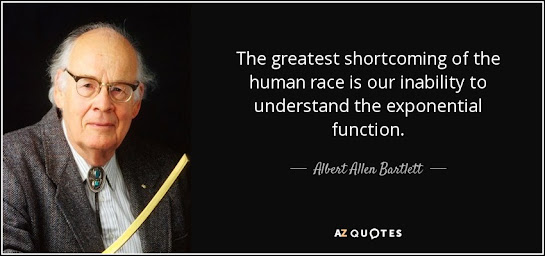
This article explains where we are right now in terms of how earth systems have so far provided us with the courtesy of a grace period for the bill coming due, and how this grace period is now ending. Exponential change is on the way.
A post from Racing Extinction details the plastics predicament (calling it a "problem"). Not to point out the obvious here, but the one thing that most people don't generally appear to recognize is the lag effect. For instance, with regards to climate change, we were already pretty well screwed 30 to 40 years ago. What we have done since then has more or less sealed our fate. Sadly, the same phenomenon occurs with every other predicament including pollution loading (and this isn't limited to just plastics by any means), where what we have released into the environment ALREADY has sealed our fate. 15 to 20 years from now, we will be unable to reproduce without advanced technology, which will all but disappear over the next 30 to 40 years for all but the 1%.
Sure, we can attempt to reduce plastic waste now, but what has already been introduced into the environment will continue to degrade and increase plastic pollution levels for decades to come, making any efforts made noble but insufficient.
Sure, we can attempt to reduce plastic waste now, but what has already been introduced into the environment will continue to degrade and increase plastic pollution levels for decades to come, making any efforts made noble but insufficient.
An older article but just as poignant, this story published in this archived version of The Atlantic points out how a large percentage of our clothing is no longer made of natural fabrics. Take a look at the clothes you have on right now. How much of it is polyester or some other type of plastic? When we wash and dry them, we are distributing them into the sewers and air, which then continue into streams, rivers, lakes, and oceans downstream, as well as the atmosphere, which then covers literally everything with microplastics and nanoplastics. Is it any wonder why we have micro- and nanoplastics in our bodies and bloodstreams? Even if we stopped all plastics production immediately, how long would we continue shredding plastics into the future just as part of wearing and cleaning our clothing?
"Once the rubble stops bouncing, reorganizing both the Chinese and American economies away from capitalism and growth, and towards a managed decline dictated by rising temperatures, falling mineral reserves and a shrinking population will still prove to be an enormous quest—a challenge, our current crop of deeply corrupted leaders seem increasingly unable to rise to. The coming crisis will thus not only put an end to our financial system, but also call the legitimacy of our entire political economy into question—no wonder everything is being done to delay its arrival."
The financial system collapsing will be bad, no doubt, but survivable. In this article, Tom Murphy explains why and how the agricultural system is far from sustainable, and demonstrates precisely why it is a mistake to base future outcomes on today's realities, meaning more precisely that there is an easily predictable outcome of the mass extinction we are currently part of. UPDATE: I just came across a new article from Dave Pollard who mentions Murphy and Smaje in it, and like him, I too found it difficult to figure out Smaje's claims.
I could go on posting link after link here, but by now I think you get the picture. I should probably discontinue this practice of posting link after link after link to demonstrate the difference between solvable problems and predicaments which only have outcomes. But let's face it, if **I** find these articles, videos, and other media interesting, I have little doubt that others will also.
I will have at least two more articles this month going into more detail on the predicaments we face, why they are intractable, and what can be done about them moving forward. I'm sitting here chuckling at just how many different ways I can say the same thing over and over. One thing I am certain of - dark humor helps to cope with the onslaught of bad news. Coping skills are particularly great to work on here at the end of civilization or what I am used to seeing - TEOTWAWKI - The End Of The World As We Know It. Obviously, the world isn't really ending; just many species of life here in this world. We have become collectively a can-kicking species, and now that we've been kicking that can down the road so long, we are running out of road.
Until next time, here is this week's set of pictures; Lake Front Hotel and Glimmerglass Queen!





another excellent post, thanks... & i for one like all your links!
ReplyDelete